
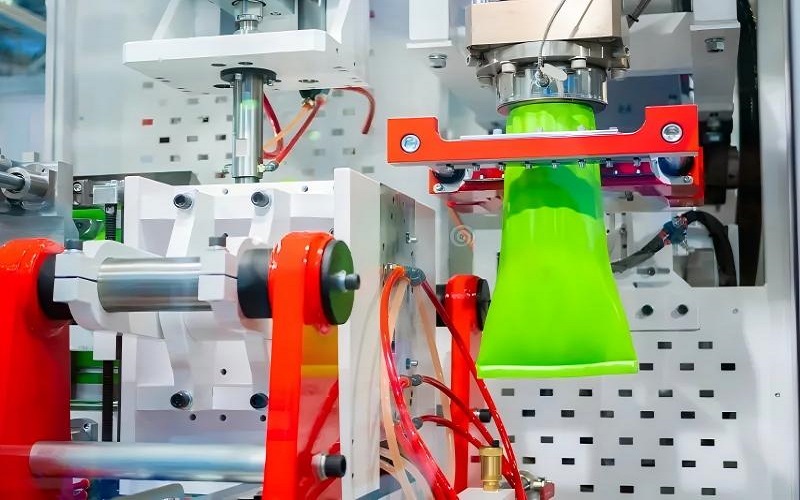
Walk down any supermarket aisle and you’re surrounded by blow molding without even knowing it.
The water bottles, milk jugs, motor oil containers, and squeeze bottles lining the shelves — virtually all of them were shaped using the blow molding process.
It’s one of the most efficient and widely used methods in the plastics industry for creating hollow plastic parts at scale, and polyethylene is at the heart of most of it.
This guide covers everything you need to know about blow molding polyethylene — how the process works, the three main types, the materials involved, and the wide range of blow molding applications across industries.
What Is Blow Molding and How Did It Begin
Blow molding is a manufacturing process for forming hollow plastic parts. The core idea is simple: heat plastic until it’s soft, inflate it with compressed air inside a mold, let it cool, and eject the finished part.
The result is a lightweight, seamless hollow part produced quickly and at low cost per unit.
The principles behind plastic blow molding actually stretch back much further than most people realize.
The fundamentals of blow molding have been around since at least the 1st century B.C., when glass blowing was first developed.
The modern plastic version took shape in 1938, when Enoch Ferngren and William Kopitke produced a blow molding machine and sold it to Hartford Empire Company — marking the beginning of industrial-scale hollow plastic parts production.
Why Polyethylene Dominates Blow Molding?
Of all the resins available in the plastics industry, polyethylene has become the dominant material for blow molded parts.
High density polyethylene, or HDPE, is the most commonly blow molded plastic material, used in everything from bottles for consumer liquids and fuel tanks to industrial drums and carrying cases.
Low density polyethylene, or LDPE, handles softer applications that demand high stress crack resistance and flexibility — think squeeze bottles and plastic bags.
Both forms of density polyethylene offer a combination of impact resistance, toughness, and chemical compatibility that makes them ideal for the blow molding process.
How the Blow Molding Process Actually Works?
At its core, the blow injection molding process is straightforward.
Plastic pellets — most often HDPE or another polyethylene resin — are fed into a blow molding machine, melted down, and formed into a hollow tube called a parison.
The mold closes around that parison, high pressure air is blown in, and the soft plastic inflates outward until it takes the shape of the mold cavity. Then it cools, hardens, and gets ejected.
Wall thickness is one of the most important variables to control throughout this sequence.
Inconsistent wall thickness leads to weak spots, warping, and parts that fail under stress.
Pressurized air has to be delivered at a consistent pace, and cooling has to happen evenly — rush either of those steps and the quality of the molded parts suffers.
Most blow molded parts also require a trimming step at the end to remove excess plastic, called flash, from the edges.
That flash is material waste, but in most polyethylene operations it gets reground and fed back into production, which keeps material costs down.
The whole cycle — from melting to ejection — can happen in seconds for small parts, making blow molding one of the fastest ways to produce hollow plastic parts in large quantities.
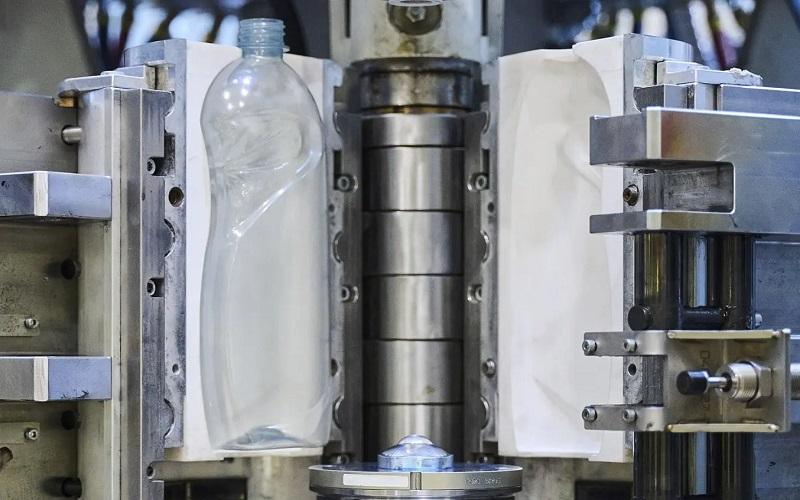
The Three Main Types of Blow Molding
Not all blow molding is the same. The three main types — extrusion blow molding, injection blow molding, and injection stretch blow molding — each serve a different range of applications, and choosing the wrong one for a project means either overpaying for precision you don’t need or cutting corners where quality matters.
Extrusion Blow Molding
Extrusion blow molding is the workhorse of the group.
Molten plastic is extruded continuously into a parison, the mold closes around it, and air does the rest.
It’s the simplest method, achieves the lowest per-part cost, and handles HDPE exceptionally well — which is why it’s the standard process for industrial drums, agricultural tanks, automotive fluid bottles, and motor oil containers.
The trade-off is that EBM isn’t suited for fine detail or tight tolerances. If the part is relatively simple and production volume is high, EBM is almost always the right answer.
Injection Blow Molding
Injection blow molding adds a layer of control by injecting molten plastic into a preform mold before blowing, rather than extruding a parison.
That extra step translates into better dimensi onal accuracy, cleaner surface finish, and the ability to produce more complex shapes consistently.
IBM is the preferred method for pharmaceutical bottles, personal care products, and healthcare applications where precision and appearance aren’t optional.
Tooling costs run higher than EBM, but for industries where every millimeter matters, the investment is justified.
Injection Stretch Blow Molding
Injection stretch blow molding takes things further still. Before blowing, a mechanical rod stretches the preform axially, creating biaxial orientation in the material.
That orientation is what gives PET bottles their clarity, strength, and barrier performance — properties that EBM and standard IBM simply can’t match.
ISBM is the reason soft drink bottles and water bottles look the way they do, and it’s capable of producing ovoid, square, and polygonal shapes that other methods struggle with.
Processing takes slightly longer, but the results speak for themselves.
| Feature | Extrusion Blow Molding | Injection Blow Molding | Injection Stretch Blow Molding |
| Cost per Part | Lowest | Medium | Medium–High |
| Tooling Cost | Low | Higher | Higher |
| Complexity | Simple shapes | Complex shapes | Complex + fine detail |
| Best Resin | HDPE, LDPE | HDPE, PP, PVC | PET |
| Typical Products | Bottles, fuel tanks, drums | Pharma, cosmetics bottles | Soft drink, water bottles |
| Tolerances | Standard | Tight | Tightest |
Why Polyethylene Is the Material of Choice?
Polyethylene’s dominance in blow molding comes down to a combination of properties that few other plastics can match across such a wide range of applications.
High density polyethylene brings high toughness, impact resistance, and excellent stress crack resistance — critical for fuel tanks, industrial drums, and carrying cases that take a beating in the field.
Low density polyethylene is softer and more flexible, making it the natural fit for squeeze bottles and plastic bags where the material needs to deform without splitting.
Beyond polyethylene, PET is the go-to resin for clear containers and carbonated beverage bottles, valued for its barrier properties and optical clarity.
Polypropylene handles heat and chemical exposure better than most plastics, making it useful for industrial packaging and automotive components that live under the hood.
PVC fills a specific niche for products like boat fenders and traffic cones, where flexibility and outdoor durability matter more than clarity or rigidity.
Each resin brings something different, but for sheer volume and versatility across blow molding applications, no material comes close to polyethylene.
Blow Molding Applications Across Industries
The blow molding process produces an enormous range of products across virtually every major industry.
Its ability to form different shapes efficiently and at large quantities makes it one of the most versatile forming processes available.
Packaging Industry
The packaging industry is the most well-known user of blow molding, producing plastic bottles and enclosures for consumer liquids, food, personal care products, and household chemicals.
Water bottles, milk jugs, squeeze bottles, and industrial drums are classic examples of blow molding products that rely on HDPE’s combination of toughness, impact resistance, and stress crack resistance to perform reliably.
Automotive Industry
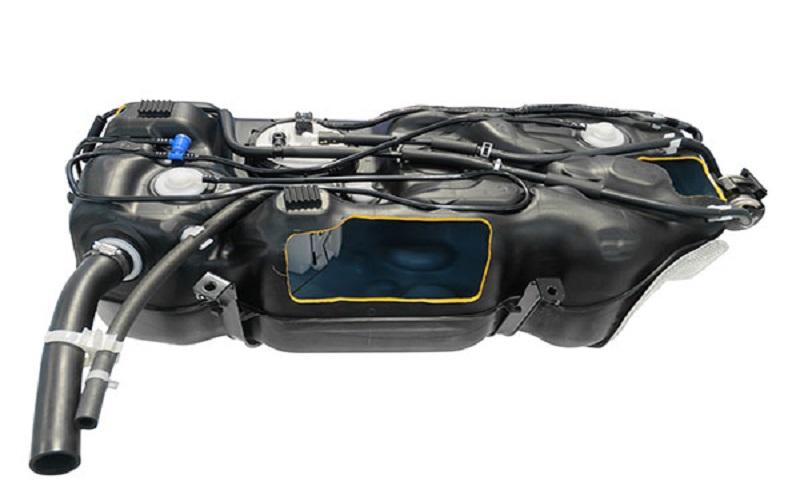
Blow molding is widely used in the automotive industry for components such as fuel tanks, intake assemblies, ducting, and fluid reservoirs.
HDPE fuel tanks produced through extrusion blow molding have largely replaced metal tanks in modern vehicles due to their lighter weight, corrosion resistance, and ability to be formed into complex shapes that fit tightly within a vehicle’s undercarriage.
Under hood components that need to withstand heat and vibration are also common automotive blow molding applications.
Agricultural and Industrial Use
The agricultural industry relies on blow molding for bulk containers, irrigation parts, and fluid reservoirs.
Large-volume HDPE tanks and industrial drums are staple products in this sector — tough, chemically resistant, and built to handle outdoor exposure over extended periods.
Industrial packaging across manufacturing and logistics also leans heavily on blow molded parts for carrying cases, storage containers, and machine components.
Healthcare Applications
Healthcare applications demand precision, cleanliness, and regulatory compliance.
Injection blow molding’s tighter tolerances and cleaner parting lines make it the preferred method for pharmaceutical bottles, medical fluid containers, and laboratory equipment.
The ability to produce consistent wall thickness and controlled shapes at high quality makes IBM the natural fit for this demanding sector.
The Role of 3D Printing in Modern Blow Molding
The blow molding industry is not standing still. 3D printing is improving the efficiency and effectiveness of plastic blow molding in ways that would have seemed impractical just a decade ago.
Companies can now prototype and design molds in-house using 3D printing, reducing costs and turnaround time dramatically compared to traditional metal tooling.
Unilever has validated the use of 3D printed molds for low-volume stretch blow molding — a clear signal that this technology is moving from experimental to mainstream.
The integration of 3D printing in blow molding gives manufacturers greater control over the development of hollow plastic parts, enabling faster iteration and more responsive product development.
Conclusion
Blow molding polyethylene is one of the most practical and scalable manufacturing processes in the plastics industry.
Whether it’s a simple HDPE milk jug, a precision pharmaceutical bottle, or a high-clarity PET soft drink container, the blow molding process delivers consistent quality hollow plastic parts at a speed and cost that few other methods can match.
Understanding the three main types — extrusion blow molding, injection blow molding, and injection stretch blow molding — and knowing which resin to pair with each process is the foundation of getting blow molding right.
As 3D printing continues to reshape tooling and prototyping, the efficiency gains ahead for blow molding are only going to grow.