
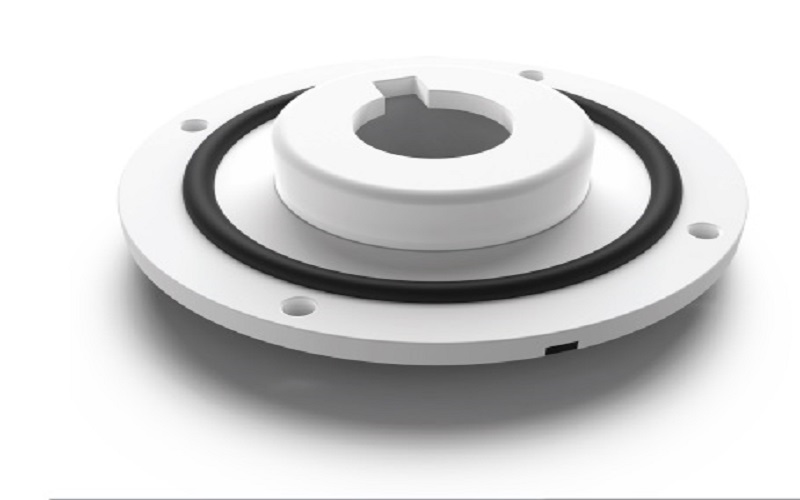
Some of the most useful products ever designed are useful precisely because they combine two things that couldn’t be more different.
A surgical instrument that’s rigid enough to perform with precision but soft enough to grip securely under pressure.
A power tool handle that absorbs shock without losing structural support. A wearable device that’s tough on the inside and comfortable against skin.
None of these are possible with a single material. They exist because of overmolding — a manufacturing process that combines two or more materials into a single integrated component in ways that no other technique can replicate, offering significant benefits such as cost savings, improved manufacturing efficiency, and enhanced functionality.
This guide covers the best overmolding materials available, how to approach material selection for different applications, and what makes the overmolding process so valuable across industries from medical devices to consumer electronics to automotive parts.
What Overmolding Actually Is
Overmolding is an injection molding process where a second material is molded directly over a previously molded part — the substrate — to create a single component with the combined properties of both materials.
The injected material bonds to the substrate surface either through a chemical bond, a mechanical bond, or both, depending on the materials involved and the tooling design.
The result is a finished part that achieves characteristics no one material could provide on its own.
Overmolding can significantly enhance product functionality by combining different materials to achieve improved grip, cushioning, chemical resistance, and aesthetics simultaneously.
The overmolding process can also reduce production costs by eliminating secondary assembly operations — instead of bonding or welding two separate components together after manufacturing, the part comes out of the mold cavity already integrated.
That elimination of secondary assembly steps reduces the potential for assembly errors and improves consistency across production runs.
How It Differs from Insert Molding
Overmolding and insert molding are related but distinct injection molding techniques.
Insert molding involves placing a pre-formed component — typically metal, such as threaded inserts or metal components — into a mold cavity before injection, so the plastic forms around it in a single shot.
Overmolding, by contrast, involves a previously molded part — usually plastic — as the substrate, with a soft material or second material injected over it in a subsequent step.
Both processes combine multiple materials in a single component, but the substrate type, tooling design, and processing approach differ in ways that matter for material selection and production cost.
Overmolding Techniques: Two-Shot, Pick-n-Place, and Co-Injection
Overmolding techniques include two-shot molding, pick-n-place molding, and co-injection molding, each offering different methods for combining materials in a single part.
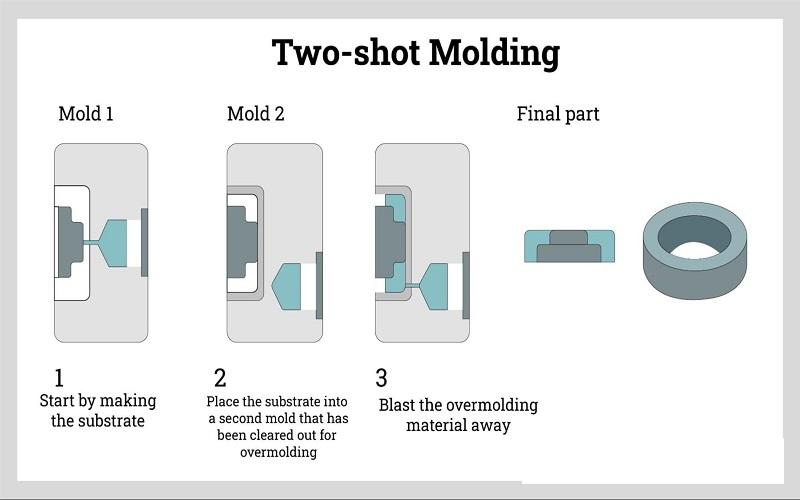
Two-shot molding involves injecting two materials sequentially into a single mold, while pick-n-place molding requires manually placing the substrate into a second mold for overmolding.
Two shot molding keeps the substrate in the machine and rotates it to a second mold cavity for the overmold shot, which improves cycle efficiency and dimensional stability between the two materials.
Pick-n-place is more flexible and better suited to lower volume production or situations where the substrate comes from a separate manufacturing process.
Co-injection overmolding allows for simultaneous injection of two materials—or an other material such as an alternative resin or substrate—into a mold cavity, enhancing bond strength and material distribution compared to traditional methods.
It’s a more technically demanding process but produces particularly strong integration between the first material and the second material, especially for components where the boundary between materials needs to perform under stress or chemical exposure.
Multi shot molding extends this further, combining three or more materials in a single component — useful for complex assemblies in consumer electronics or medical devices where enhanced functionality requires properties that two materials alone can’t deliver.
The Critical Role of Material Compatibility
Material selection for overmolding requires balancing tactile needs with performance requirements and manufacturing compatibility. There are many resins available for overmolding, each offering unique properties to meet diverse application needs.
Get it wrong and the bond fails — either immediately or under the environmental factors the product will face in use.
Get it right and the overmolded part performs better than any assembly of separate components could.
Chemical compatibility is essential for a permanent bond between overmold material and substrate during injection.
When the overmold material and substrate material are chemically compatible, the heat and pressure of injection creates a molecular bond at the interface that’s stronger and more reliable than any adhesive or mechanical fastener.
When chemical compatibility isn’t achievable — as is the case with certain engineering plastics like polypropylene, which has low surface energy — mechanical bonding features such as through-holes or undercuts in the substrate may be necessary to create a secure mechanical bond between the two materials.
Overmolding materials must also have a lower melting point than the substrate to prevent deformation of the previously molded part during the manufacturing process.
This is a key consideration that narrows the field of suitable materials for any given substrate, and it’s one of the first things to establish during tooling design.
Surface preparation of the substrate surface also affects bond quality.
Contaminants, mold release agents, and moisture all interfere with both chemical and mechanical bonding.
Ensuring the substrate surface is clean and properly prepared before overmolding is a basic but critical step in the process.
The Best Overmolding Materials
The overmolding materials that consistently deliver optimal performance across the widest range of applications, as molding material options, are thermoplastic elastomers, thermoplastic polyurethane, and liquid silicone rubber.
Each brings a distinct combination of properties, and the ideal molding material depends on the substrate, the application environment, and the desired properties of the finished part.
Thermoplastic Elastomers (TPE)
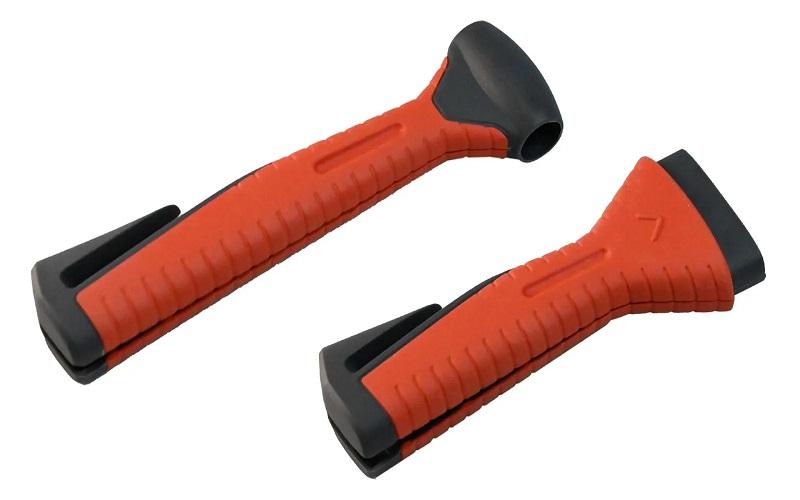
Thermoplastic Elastomers are a versatile choice for overmolding due to their excellent bonding properties, flexibility, and shock absorption, making them ideal for ergonomic grips and seals in various applications.
TPEs combine the processing characteristics of thermoplastics with the feel and performance of rubber — they can be injection molded using standard equipment, they bond well to a wide range of substrate materials, and they deliver the soft touch features that consumer products, wearable devices, and medical devices increasingly demand.
TPEs bond particularly well to acrylonitrile butadiene styrene and other common engineering plastics, which is one reason they’re so widely used in consumer electronics, hand tools, and ergonomic grips.
Their flexibility, impact resistance, and shock absorption make them effective for protecting sensitive components from mechanical stress and vibration. For overmolding applications where the goal is enhancing grip, cushioning, or soft overmolding over a rigid substrate, TPE is often the first material to evaluate.
Thermoplastic Polyurethane (TPU)
Thermoplastic Polyurethane exhibits high abrasion resistance, durability, flexibility, and good chemical resistance — a combination that makes it the ideal material for overmolding applications where the finished part needs to withstand harsh environments, chemical exposure, or repeated mechanical stress.
TPU is tougher than standard TPE and holds up better in demanding conditions, which is why it’s commonly chosen for automotive components, industrial equipment, and wearable devices that need to perform reliably over time.
TPU’s good chemical resistance also makes it suitable for applications where the overmolded part will be exposed to oils, solvents, or cleaning agents — a common requirement in automotive parts and industrial applications.
Its flexibility and impact resistance allow it to absorb shock and dampen vibration without cracking or deforming, which adds to its value in applications requiring both structural support and protection for electronic components or sensitive components housed within.
Liquid Silicone Rubber (LSR)
Liquid silicone rubbers can be overmolded onto various substrates, providing enhanced functionality due to their flexibility, temperature resilience, and durability, making them suitable for medical and consumer products.
LSR is the material of choice when the application involves extreme temperatures, aggressive chemical exposure, or direct contact with the human body — conditions where thermoplastic elastomers may not be sufficient.
In medical devices, LSR is valued for its biocompatibility, sterility, and ability to withstand autoclave sterilization cycles.
Overmolding is widely used in the medical industry for devices that contact or enter the body, as it allows for the combination of materials that meet stringent requirements for safety and sterility.
Surgical instruments, wearable medical devices, and components used in diagnostics all make use of LSR overmolding because it combines the structural properties of the substrate with the biological safety and soft material performance that patient contact demands.
LSR also delivers excellent sealing performance — overmolding can improve the durability and reliability of products by integrating seals and gaskets directly into the design, which reduces the potential for assembly errors and enhances performance in demanding environments.
For electronic components that need environmental sealing against moisture or dust, LSR overmolding provides a level of protection that’s difficult to achieve through any other method.
Acrylonitrile Butadiene Styrene (ABS) as a Substrate
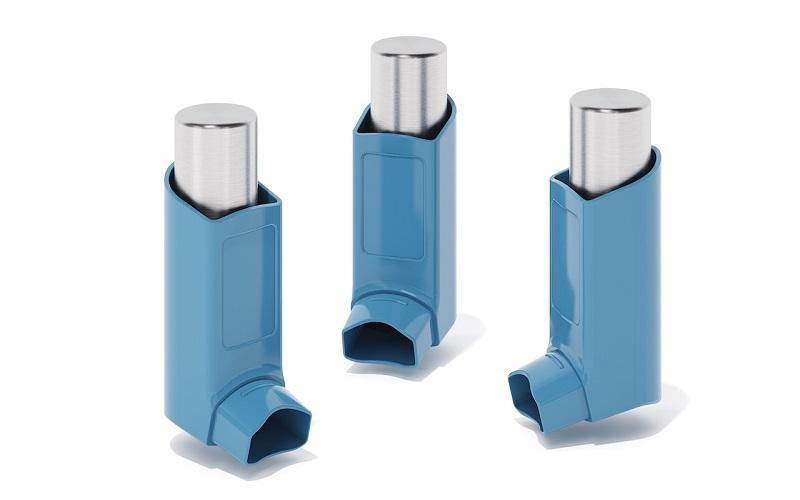
Acrylonitrile Butadiene Styrene is widely used for consumer products and automotive parts due to its reasonable chemical compatibility with soft thermoplastic elastomers used for grip and seal applications.
As a substrate material, ABS offers dimensional stability, impact resistance, and the structural rigidity needed to support a soft overmold without deforming under injection pressure.
It’s one of the most commonly used substrate materials in two shot molding and pick-n-place overmolding processes precisely because it bonds reliably with TPE and TPU without requiring specialized surface preparation.
Polypropylene: Challenges and Solutions
Polypropylene is commonly used for low-cost and disposable applications, but its low surface energy makes it challenging for traditional overmolding.
Specialized TPEs have been developed to improve adhesion to polypropylene substrates, making it possible to overmold soft touch features onto PP components where chemical bonding would otherwise be unreliable.
For cost-effective, high volume applications in packaging or disposable medical devices where polypropylene makes economic sense as the substrate, these specialized TPE formulations offer a workable solution.
Polyetherimide (PEI) for High-Performance Applications
Polyetherimide is a high-performance polymer known for its good thermal, mechanical, and chemical properties, making it suitable for applications requiring high strength and temperature resistance, particularly in medical devices.
As a substrate material in overmolding applications, PEI provides the structural backbone for components that operate in high-temperature environments or require compliance with stringent regulatory standards.
Its compatibility with LSR and certain engineering-grade TPEs makes it a viable substrate for demanding overmolding applications in medical, aerospace, and industrial sectors.
Overmolding Across Industries
Overmolding is used in a wide range of industries. In addition to overmolding, ultrasonic welding is another technique used in industry for bonding components, especially when integrating metal inserts or assembling multi-material parts, offering a chemical-free alternative to overmolding in some scenarios.
Medical Devices and Surgical Instruments
Overmolding is widely used in the medical industry for devices that contact or enter the body, as it allows for the combination of materials that meet stringent requirements for safety and sterility.
Surgical instruments benefit from overmolding because the process allows a rigid metal component or engineering plastic core to be paired with a soft material grip that improves tactile control, reduces hand fatigue, and can be sterilized without degrading.
Wearable devices in healthcare settings use overmolded LSR or TPE to create comfortable skin-contact surfaces over rigid electronic components housing sensitive sensors and circuitry.
Consumer Electronics and Wearable Devices
In consumer electronics, overmolding protects sensitive components from impact, moisture, and chemical exposure while improving the user experience through soft touch features and ergonomic grips.
Smartphones, earbuds, cables, and wearable devices all use overmolded materials to combine structural support from engineering plastics with the soft material performance that users expect from modern consumer products.
Two shot molding and multi shot molding are particularly common in consumer electronics manufacturing because they offer the precision and repeatability needed for high volume production of complex shapes with tight tolerances.
Automotive Components
Automotive applications of overmolding include components like steering wheels and shift knobs, where a soft overmold improves tactile feel and noise damping, enhancing user comfort.
Beyond interior trim, overmolding is used extensively for under-hood automotive components that need to withstand high temperatures and chemical exposure — conditions where TPU’s abrasion resistance and chemical resistance make it the ideal material.
Seals, gaskets, and vibration-damping mounts in automotive parts frequently use overmolded thermoset materials or LSR to deliver reliable performance in harsh environments over the life of the vehicle.
Hand Tools and Consumer Products
In consumer products, overmolding is commonly applied to enhance the grip and comfort of items such as toothbrushes, hand tools, and electronic devices by adding a soft layer of material over a hard substrate.
The combination of a rigid ABS or polypropylene core with a TPE soft overmolding creates the ergonomic grip that consumers associate with quality in hand tools, personal care products, and sporting equipment.
It’s a straightforward application of the overmolding process, but it demonstrates clearly why combining multiple materials in a single component adds value that a single material design simply cannot match.

Key Considerations for Material Selection
Selecting materials for overmolding requires working through several key considerations systematically rather than defaulting to the most familiar option.
Chemical compatibility between the overmold material and the substrate material is the starting point — without it, the bond will be unreliable regardless of how well everything else is executed.
Processing temperature compatibility must be verified to ensure the injected material won’t deform the previously molded part. The environmental factors the finished component will face — temperature range, chemical exposure, UV exposure, mechanical stress — determine which material properties are non-negotiable.
And production cost considerations, including material cost, tooling design complexity, and cycle time, need to be balanced against performance requirements to arrive at a solution that’s both technically sound and commercially viable.
Working closely with material suppliers during the design phase provides access to compatibility data, bond strength testing, and application experience that can significantly reduce the risk of selecting unsuitable materials for a given overmolding application.
Side-by-Side: Overmolding Material Comparison
| Material | Key Properties | Best Applications | Substrate Compatibility |
| TPE | Flexibility, grip, shock absorption | Consumer products, ergonomic grips | ABS, PC, Nylon |
| TPU | Abrasion resistance, chemical resistance | Automotive, industrial, wearables | ABS, PC, metals |
| LSR | Biocompatibility, temperature resilience, sealing | Medical devices, electronics sealing | PC, PEI, metals |
| ABS (substrate) | Dimensional stability, rigidity | Consumer electronics, automotive | Bonds well with TPE, TPU |
| PEI (substrate) | High temp resistance, strength | Medical, aerospace | Compatible with LSR, TPE |
Final Thoughts
The best overmolding materials aren’t the most exotic or the most expensive — they’re the ones that match the substrate, suit the application environment, meet the performance requirements, and can be processed reliably within the constraints of the tooling design and production process.
Thermoplastic elastomers cover the widest range of general overmolding applications. Thermoplastic polyurethane adds abrasion resistance and chemical resistance for more demanding conditions. Liquid silicone rubber delivers biocompatibility and sealing performance where nothing else will do.
Material selection for overmolding is ultimately about understanding what each material brings to the combination — and choosing the pairing that produces a finished component with the optimal performance, durability, and functionality that no single material could achieve alone.