
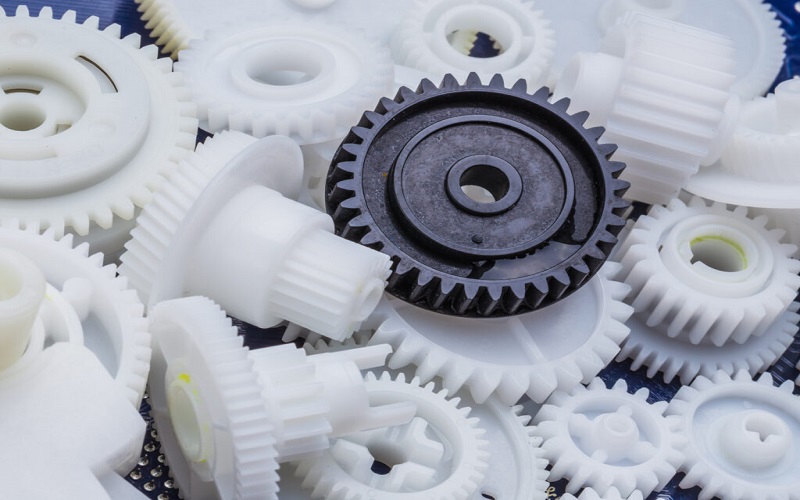
If you’ve ever taken apart a mechanical pencil, looked inside a car door lock, or handled a precision gear from an industrial machine, there’s a good chance you’ve already held a POM part without knowing it.
POM — polyoxymethylene — is one of those engineering plastics that quietly does a lot of the heavy lifting in modern manufacturing.
It doesn’t get the same attention as nylon or polycarbonate, but among engineers and manufacturers who need precision parts with tight tolerances, low friction, and reliable dimensional stability, POM is often the first material they reach for.
This guide covers what POM material actually is, what makes it perform the way it does, and where it genuinely excels in real-world applications.
What Is POM Material?
POM is derived from formaldehyde and consists of long, repeating oxymethylene chains.
That chemical structure gives POM its high crystallinity — the molecules pack tightly and regularly, which is the root cause of most of its standout mechanical properties.
POM plastic goes by several names depending on the context: polyoxymethylene, acetal resin, acetal homopolymer, and acetal copolymer are all terms you’ll encounter, and they all refer to variations of the same engineering thermoplastic family.
As a versatile engineering material, POM sits in the category of high performance engineering components — alongside nylon, PEEK, and polycarbonate — but with a specific set of properties that makes it better suited than those materials for certain applications.
POM is often used as a direct replacement for metal parts, such as brass or zinc, due to its superior wear resistance and lighter weight.
That ability to substitute for metal while offering easier processing, lower weight, and competitive mechanical strength is one of the key reasons POM has become so widely used across industries.
Homopolymer POM vs Copolymer POM: Key Differences
Before getting into properties, it’s worth understanding that not all POM is the same.
There are two main types — homopolymer POM (POM-H) and copolymer POM (POM-C) — and they have meaningfully different properties that affect material selection.
Homopolymer acetal (POM-H) is produced via the polymerization of a single monomer, resulting in a regular crystalline molecular structure, while copolymer acetal (POM-C) is produced by polymerizing two different monomers, leading to a more amorphous structure.
That structural difference flows through to performance: POM-H generally exhibits better mechanical performance, outperforming POM-C by about 15% in hardness, stiffness, tensile strength, and compressive strength.
If your application demands the highest possible mechanical strength and stiffness, homopolymer acetal is the stronger performer.
However, POM-C has its own advantages that make it the preferred choice in many situations.
POM-C has a significantly reduced degree of centerline porosity compared to POM-H, which results in less outgassing and greater resistance to a broader range of chemicals.
In terms of chemical resistance, POM-C exhibits better performance in a wider pH range of 4 to 13 compared to POM-H’s range of 4 to 9, making it more suitable for various chemical applications.
POM-C can also withstand higher continuous operating temperatures in air — 100°C compared to POM-H’s 90°C — making it suitable for applications requiring better thermal stability.
For environments involving chemical exposure, moisture, or slightly elevated temperatures, copolymer versions generally offer more consistent long-term performance.
Key Mechanical Properties of POM
POM’s reputation as a high-performance engineering material is built on better mechanical properties that remain consistent even at low temperatures, combined with high dimensional stability for precision tolerances. In demanding applications where most polymers fail, these synergistic traits dictate performance; here is what the empirical numbers actually look like.
High Strength and Stiffness
POM exhibits high tensile strength of up to 90 MPa and hardness, making it a cost-effective substitute for non-ferrous metals.
POM is a strong and hard plastic, comparable in strength to epoxy and aluminum, but more flexible than these materials — which gives it an advantage in applications where some degree of flex or impact absorption is needed alongside high mechanical strength.
The high stiffness and flexural strength of POM mean that parts hold their shape under load, which is critical for precision gears, structural clips, and load-bearing components that can’t afford to deform in service.
Low Coefficient of Friction and Good Wear Resistance
This is where POM truly distinguishes itself from other engineering plastics. POM has a very low coefficient of friction of 0.2 to 0.3, making it ideal for sliding parts without needing external lubricants.
That self-lubricating characteristic means POM is commonly used in applications requiring precision parts such as gears, bearings, and other moving components due to its high strength and low friction properties.
Due to its excellent wear resistance and low friction, POM is often used in applications such as conveyor belts and safety restraints, where durability and performance under load are critical.
The abrasion resistance of POM also contributes to its long service life in moving part applications.
Compared to other plastics, POM maintains its surface integrity over many millions of cycles — a key reason it appears so consistently in high-cycle mechanical components across automotive, industrial, and consumer electronics applications.
Dimensional Stability and Low Moisture Absorption
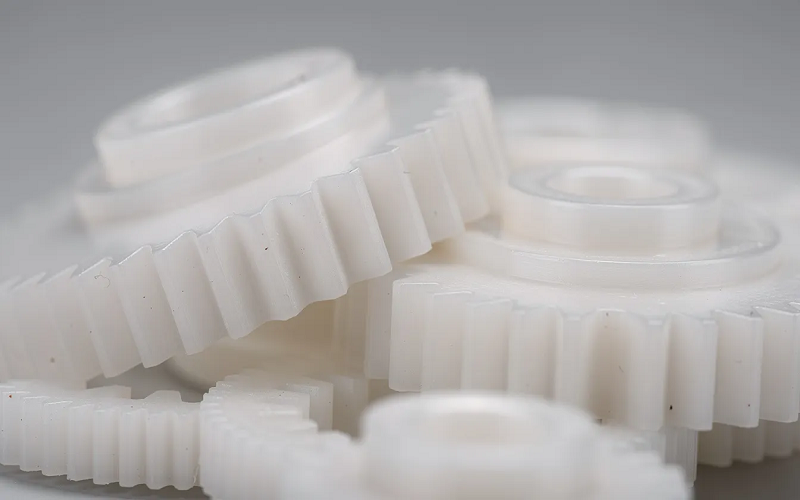
POM sets the benchmark for precision parts by merging excellent mechanical properties with exceptional dimensional stability—a non-negotiable requirement that few other engineering thermoplastics can satisfy.
POM has low moisture absorption of less than 0.2%, ensuring parts maintain their shape and size in humid or wet environments.
That low water absorption is directly tied to the high crystallinity of POM’s molecular structure — water molecules simply can’t penetrate the tightly packed crystal lattice the way they can in more amorphous polymers.
POM has very low shrinkage, with only 0.17% shrinkage from 165°C to 20°C, making it dimensionally stable during cooling.
For manufacturers producing parts to close tolerances, that predictability during and after processing is a significant practical advantage.
Parts made from POM sheets or injection molded POM hold their dimensions reliably across a range of operating conditions, which reduces the need for post-processing adjustments and improves assembly consistency.
Fatigue Resistance and Creep Resistance
POM exhibits excellent fatigue resistance, allowing it to withstand multiple load and unload cycles without significant deformation.
Combined with its creep resistance — the ability to maintain shape under sustained load over time — this makes POM parts reliable in applications where both cyclic stress and constant loading are present.
Springs, snap-fit connectors, and flexible linkages all benefit from this combination of fatigue resistance and the ability to return to their original shape after deformation.
Chemical Resistance: Strengths and Limitations
POM possesses excellent chemical resistance to many organic solvents, fuels, and oils, while maintaining good resistance to a broad range of neutral chemicals. However, it remains vulnerable to strong acids and bases—a distinction that matters enormously in application selection, much like its characteristic combustion behavior marked by a clean blue flame.
POM is well suited for fuel system components, hydraulic fittings, and industrial parts that encounter hydrocarbons and most common industrial chemicals.
Its good chemical resistance in neutral to mildly acidic environments makes it a reliable choice for food processing equipment and consumer goods that face cleaning agents and water exposure.
However, POM is sensitive to acid hydrolysis and oxidation, making it susceptible to degradation when exposed to strong acids and chlorine.
Applications involving bleach-based cleaners, acidic processing fluids, or chlorinated water need to account for this limitation.
POM-C’s broader pH tolerance of 4 to 13 gives it more headroom in mildly aggressive chemical environments compared to POM-H, but neither grade is appropriate for strongly acidic or strongly alkaline conditions.
Thermal Properties and Heat Resistance
POM’s thermal performance is solid within its operating range but has a defined ceiling.
POM has a relatively low upper working temperature of around 90°C for POM-H and 100°C for POM-C, which limits its use in high-temperature applications compared to engineering plastics like PEEK or PPS.
The heat deflection temperature of POM supports reliable performance in most ambient industrial and automotive interior environments, but under-hood or high-process-temperature applications require careful evaluation.
The thermal stability of POM is generally good within its operating range.
POM can maintain its mechanical properties through moderate temperature cycling, and its low coefficient of thermal expansion contributes to its excellent dimensional stability across normal operating temperature ranges.
For hot water contact applications, POM-C’s better hydrolysis resistance makes it the preferred grade — POM-H is more susceptible to degradation in sustained hot water or steam environments.
POM Injection Molding: Processing Considerations
POM injection molding is the dominant manufacturing method for POM parts, and it requires careful process control.
POM can be challenging to process due to its high-temperature sensitivity, requiring careful temperature control during molding to avoid decomposition.
When injection molding POM, it is important to maintain a medium to high injection speed and an injection pressure between 70 and 120 MPa for optimal results.
POM has a shrinkage rate of 2 to 3.5% during injection molding, with most shrinkage occurring while the part is still in the mold during the cooling stage.
That relatively high shrinkage rate is one of the processing trade-offs of working with POM — while the final part has excellent dimensional stability in service, the mold design needs to account for this shrinkage to achieve close tolerances in the finished injection molded POM part.
POM can be processed through injection molding or extrusion but has a high shrinkage rate and may warp during cooling, so gating location, cooling channel design, and wall thickness uniformity all require careful attention.
Good machinability is another practical advantage of POM.
POM sheets and rod stock machine cleanly with standard tooling, making it straightforward to produce prototypes or low-volume precision parts through CNC machining when injection molding tooling isn’t yet justified.
Common Applications of POM Across Industries
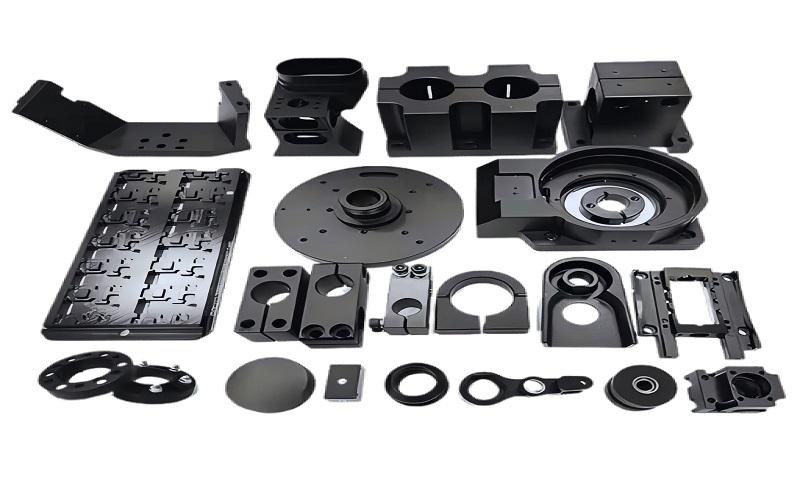
Common applications of POM include automotive components, industrial machinery parts, electronics, consumer goods, and medical devices.
That breadth reflects how well POM’s combination of properties — low friction, high stiffness, dimensional stability, and chemical resistance — maps onto the needs of precision mechanical components across different sectors.
In the automotive industry, POM parts appear in door lock mechanisms, fuel system components, seatbelt components, window regulator gears, and interior trim clips.
In the consumer electronics industry, POM is used for precision snap-fits, slider mechanisms, and small structural components in electronic devices where tight tolerances and reliable long-term performance are required.
POM is utilized in the manufacturing of food processing equipment, as certain grades are rated as food safe according to various health standards — making it a practical material for conveyor components, valve bodies, and food handling machinery.
In industrial machinery, POM’s wear resistance and low coefficient of friction make it a go-to material for bearings, bushings, pump components, and conveyor system parts.
For the food industry and medical applications, the combination of low moisture absorption, chemical resistance, and the availability of food-safe and medical-grade formulations makes POM a practical and compliant choice for demanding regulatory environments.
Comparison of POM-H and POM-C
| Property | POM-H (Homopolymer) | POM-C (Copolymer) |
| Tensile Strength | Up to 90 MPa | Up to 70 MPa |
| Hardness & Stiffness | ~15% higher than POM-C | Slightly lower |
| Continuous Use Temp (air) | 90°C | 100°C |
| Chemical Resistance pH Range | 4–9 | 4–13 |
| Centerline Porosity | Higher | Significantly lower |
| Hot Water / Hydrolysis Resistance | Lower | Better |
| Coefficient of Friction | 0.2–0.3 | 0.2–0.3 |
| Moisture Absorption | <0.2% | <0.2% |
| Best For | Max mechanical strength | Chemical exposure, thermal stability |
Conclusion
POM material earns its place as a go-to engineering thermoplastic by delivering a combination of properties that’s genuinely hard to replicate: high mechanical strength, excellent dimensional stability, low moisture absorption, a very low coefficient of friction, and good chemical resistance — all in a material that machines and molds well.
Understanding the difference between POM-H and POM-C is the starting point for selecting the right grade, and getting the injection molding process parameters right is what turns those material properties into reliable, high performance engineering components.
Whether you’re replacing a metal gear, designing a food-safe conveyor part, or specifying components for the consumer electronics industry, POM is a material worth knowing well.