
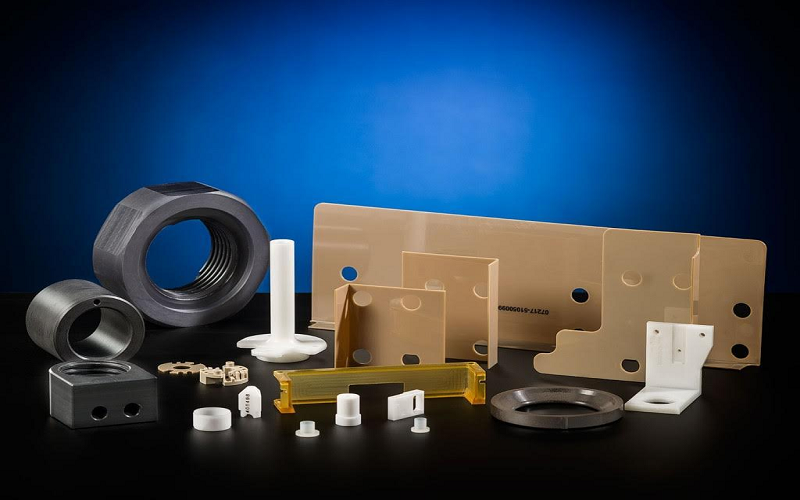
High temperature plastics are a category of special materials that can maintain their mechanical properties and structural integrity under high-temperature conditions.
With continuous advancements in industrial technology, these heat resistant plastics are increasingly applied in fields such as aerospace, automotive manufacturing, electronic devices, and medical devices.
They not only possess excellent heat resistance but also outstanding chemical resistance and wear resistance, enabling them to withstand extreme heat and corrosive chemicals.
This article will introduce the definition of high temperature plastics, common types, and their important roles in high performance applications, helping manufacturers better understand how to select the right heat resistant material for specific needs.
What Are High Temperature Plastics?
High-temperature plastics, also known as heat resistant thermoplastics or high temperature polymers, are engineered materials designed to withstand temperatures significantly higher than conventional plastics.
These materials maintain their mechanical strength, dimensional stability, and other critical properties even when exposed to hot environments where other plastics would soften, deform, or degrade.
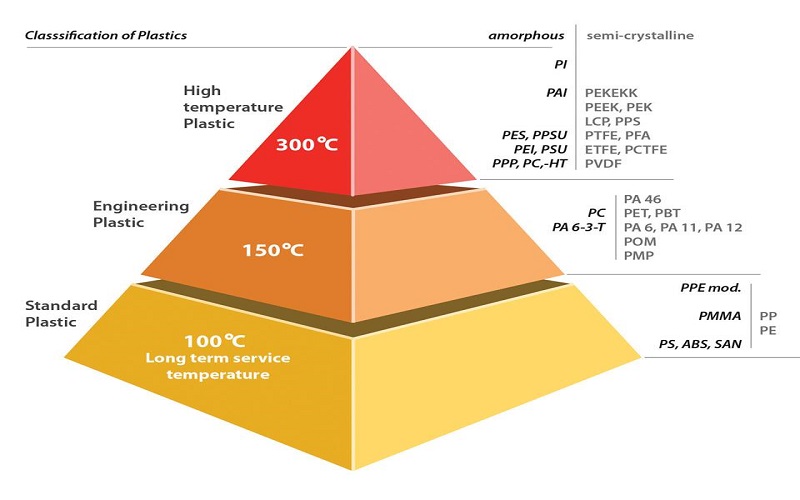
The key characteristic that defines a high-temperature plastic is its ability to withstand temperatures above 150°C, with some specialized polymers enduring continuous service temperatures well over 300°C.
This temperature resistance is often measured by properties such as heat deflection temperature (HDT) and melting point, which indicate the temperature at which the plastic begins to lose rigidity or melts.
High-temperature materials are widely used in high temperature applications that demand exceptional chemical resistance, flame resistance, and outstanding thermal and electrical insulation properties.
These materials are popular choices for manufacturing plastic parts that replace metal alloys in harsh environments, offering benefits such as lower weight, corrosion resistance, and reduced friction.
Key Indicators For Evaluating High-Temperature Plastics
The performance evaluation of high-temperature plastics mainly relies on the following key indicators, which help engineers and manufacturers select materials suitable for specific high-temperature applications:
- Continuous Use Temperature (CUT): This refers to the highest temperature that a plastic can withstand during long-term use without significantly reducing its mechanical performance and structural integrity. High-temperature plastics typically have a continuous use temperature above 150°C, with some high-performance plastics such as polyether ether ketone (PEEK) reaching over 300°C.
- Heat Deflection Temperature (HDT): HDT is the temperature at which a plastic begins to exhibit measurable deformation under a specific load. It reflects the plastic’s ability to maintain rigidity under high temperature and load, serving as an important indicator of short-term heat resistance for high-temperature plastics.
- Glass Transition Temperature (Tg) and Melting Point (Tm): Tg is the temperature at which an amorphous polymer transitions from a glassy state to a rubbery state, above which the material softens. Tm is the melting temperature of crystalline polymers. Together, these determine the thermal stability range and processing temperature window of the plastic.
Additionally, other important properties include high temperature chemical resistance, dimensional stability at high temperatures, impact resistance, and electrical insulation performance.
These properties enable high-temperature plastics to perform excellently in critical applications such as aerospace, automotive components, and electrical components.
A correct understanding and evaluation of these key indicators form the foundation for selecting suitable high-performance thermoplastics and engineering plastics.
Common Types Of Heat Resistant Plastics
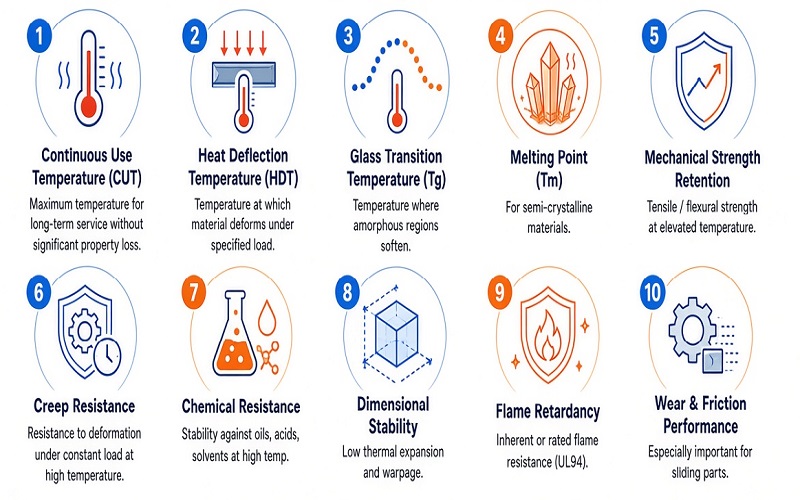
Common types of high-temperature plastics include PEEK, polyimide, PPS, and PTFE. Below are the high temperature resistance and characteristics of these materials:
Polyether Ether Ketone (PEEK)
PEEK is a popular thermoplastic known for its heat resistance, strong mechanical and chemical resistance. It can handle continuous temperatures above 250°C and short bursts up to 310°C.
It stays stable and strong under heat, making it ideal for aircraft, cars, and medical devices. PEEK also has good electrical insulation and low friction. It can be made by injection molding or CNC machining.
Polyphenylene Sulfide (PPS)
PPS is a heat-resistant plastic that works well around 220°C to 240°C. It resists chemicals, absorbs little moisture, and keeps its shape. PPS is used in cars, electrical parts, and circuit boards. It flows well for making complex shapes by injection molding.
Polytetrafluoroethylene (PTFE)
Also called Teflon, PTFE melts at about 327°C and stays stable above 260°C. It works well in very hot or cold temperatures (down to -200°C). PTFE has low friction, is chemically inert, and insulates electricity well. It’s used for seals, bearings, and electrical insulation but is less impact resistant and needs special processing.
Polyetherimide (PEI)
PEI, commercially known as Ultem, is a heat resistant thermoplastic with a maximum continuous operating temperature of about 171°C to 200°C.
It combines high strength, flame resistance, and excellent dielectric properties, making it suitable for circuit boards, aircraft components, and medical devices. PEI is both injection molded and CNC machined, allowing for precision parts with good dimensional stability.
Polybenzimidazole (PBI)
PBI is one of the highest performing heat resistant plastics, capable of withstanding continuous service temperatures up to 398°C. It offers exceptional mechanical strength, wear resistance, and chemical stability.
Due to its high cost and machining difficulty, PBI is typically reserved for specialized aerospace and industrial applications requiring extreme heat resistance.
Polyimide (PI)
Polyimides are known for extreme thermal stability and can withstand over 300°C. They are highly heat resistant and dimensionally stable, making them an excellent choice for applications requiring both durability and precision at elevated temperatures.
They are also very resistant to chemicals like solvents, which helps them last longer in tough environments. Their ability to stay stable in heat ensures they perform well in demanding conditions.
Other notable high temperature plastics include Polyphenylsulfone (PPSU), Polyamide-imide (PAI), and Polydicyclopentadiene (pDCPD). These materials offer varying balances of heat resistance, chemical resistance, mechanical strength, and processability to suit specific industrial needs.
Understanding the properties of these common heat resistant plastics helps engineers make informed choices for durable, high-performance parts.
| Material | Continuous Use Temperature | Melting Point |
|---|---|---|
| Polyether Ether Ketone (PEEK ) | >250°C (up to 310°C short-term) | >371°C |
| Polyphenylene Sulfide (PPS) | 220–240°C | ~280°C |
| Polytetrafluoroethylene(PTFE) | Stable above 260°C | 327°C |
| Polyetherimide(PEI, Ultem) | ~171–200°C | Amorphous (no melting point) |
| Polybenzimidazole(PBI) | Up to 398°C continuous | No melting point |
| Polyimide (PI) | Over 300°C | No melting point |
| Polyamide-imide (PAI) | Up to 260°C continuous | No melting point |
| Polyphenylsulfone (PPSU) | Up to 218°C continuous | Amorphous (no melting point) |
| Polydicyclopentadiene (pDCPD) | Up to 120°C heat deflection temp | Thermoset (no melting point) |
Applications Of High-Temperature Plastics
High-temperature plastics find extensive use across a wide range of industries due to their ability to maintain performance in harsh environments.
Their unique combination of heat resistance, chemical stability, and mechanical strength makes them ideal for demanding applications where other materials might fail.
Aerospace Applications
In the aerospace field, reducing weight and improving durability are crucial. High-temperature plastics such as PEEK and PBI are used to manufacture lightweight structural components, insulators, and connectors that can withstand extreme thermal cycling and harsh environments.
These materials are corrosion-resistant, lighter than metals, improving energy efficiency and machine performance, and can replace metal parts, enhancing fuel efficiency and reducing maintenance costs.
Automotive Applications
The automotive industry widely uses high-temperature plastics to manufacture engine components, transmission parts, seals, and electrical connectors.
Materials like PPS, PEEK, and PEI can withstand the high temperatures generated by engines and resist chemicals such as oil and fuel, helping to improve vehicle performance, reduce emissions, and extend part lifespan.
Electronic and Electrical Applications
High-temperature plastics are favored in the electronics industry for their excellent electrical insulation properties and thermal stability. Circuit boards, connectors, insulators, and housings commonly use materials such as PEI and PTFE to ensure stable operation of devices under high temperatures.
Medical and Healthcare Applications
In medical devices, high-temperature plastics are used for sterilizable surgical instruments, implants, and diagnostic equipment.
PEEK maintains mechanical performance after repeated autoclaving and chemical disinfection, making it the preferred choice for implants and surgical tools. Its biocompatibility and chemical resistance ensure medical safety.
Industrial and Chemical Processing
The chemical and high-temperature processing industries use PTFE and PPS to manufacture seals, gaskets, valves, and lining materials. These materials are chemically inert and heat resistant, protecting equipment from corrosion and wear, extending service life, and reducing downtime.
In summary, high-temperature plastics, with their versatility and excellent performance, are widely applied in automotive, aerospace, electronics, medical, and industrial fields to ensure equipment stability in high-temperature environments.
How To Choose Right Heat Resistant Material For High Temperature Applications ?
Selecting the appropriate heat resistant material for high temperature applications involves careful consideration of several critical factors to ensure optimal performance, durability, and cost-effectiveness. Here are key points to guide the selection process:
1. Operating Temperature Range
Understanding the continuous use temperature and the maximum short-term temperature the material will be exposed to is fundamental.
Materials like PEEK and PBI are suitable for applications requiring resistance to very high temperatures (above 300°C), while PEI and PPS might suffice for moderately high temperatures (around 170°C to 240°C).
2. Mechanical Properties
Evaluate the required mechanical strength, stiffness, impact resistance, and fatigue resistance under high temperature conditions. Some plastics, such as PEEK, retain high mechanical strength and impact resistance at elevated temperatures, whereas others may exhibit lower impact strength.
3. Chemical Resistance
Consider the chemical environment the material will face, including exposure to fuels, oils, solvents, and corrosive chemicals. PTFE, for example, is highly chemically inert, making it ideal for aggressive chemical environments.
4. Electrical Properties
For applications involving electrical insulation, materials with high dielectric strength, such as PEI (Ultem), are preferred. These materials ensure safety and reliability in electronic components operating at elevated temperatures.
5. Dimensional Stability and Moisture Absorption
Materials with low moisture absorption and high dimensional stability under heat are essential for precision parts. PPS and PEEK generally perform well in this regard.
6. Processability and Manufacturing Method
Consider the manufacturing techniques available, such as injection molding, CNC machining, or 3D printing. Some materials require specialized equipment and processing conditions due to their high melting points and viscosity.
7. Cost and Availability
High-performance plastics like PBI and PEEK tend to be more expensive and may have longer lead times. Balancing cost with performance requirements is crucial for practical applications.
8. Regulatory and Industry Standards
Ensure the selected material complies with relevant industry standards and regulations, especially for medical, aerospace, and food contact applications.
9. Environmental and Service Conditions
Take into account factors such as exposure to UV light, radiation, moisture, and mechanical wear, which may affect material performance over time.
By carefully assessing these factors and consulting material datasheets and experts, manufacturers can select the best material that meets the specific demands of their high temperature application, ensuring safety, reliability, and longevity.
In summary, selecting the right material depends on the specific application requirements such as operating temperature, mechanical load, chemical exposure, and manufacturing method.
Conclusion
In conclusion, high temperature plastics are essential materials that offer excellent performance under high heat conditions.
Their ability to maintain strength, stability, and resistance to chemicals makes them ideal for demanding applications across industries such as aerospace, automotive, and electronics. Choosing the right high heat resistant plastic ensures durability and efficiency in extreme environments.