
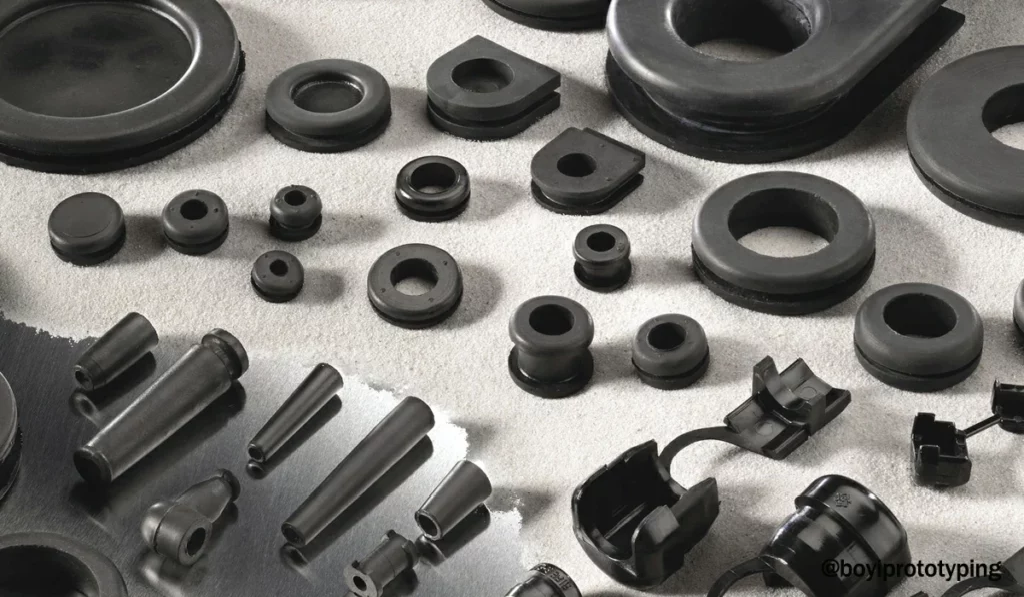
EPDM injection molding is a process suited to the high-volume production of complex rubber components, helping products achieve consistent dimensions, good elasticity, and weather resistance.
EPDM (ethylene propylene diene monomer) rubber is widely used in automotive seals, construction gaskets, HVAC components, and electrical insulation products.
This article provides a systematic overview of the basic principles of EPDM injection molding, key process parameters, common defects and their solutions, and practical applications.
It is designed to help engineers and manufacturing professionals master the technology and improve product performance and production efficiency.
Chemical Composition And Formulation Of EPDM Rubber
EPDM, known in Chinese as ethylene propylene diene monomer rubber, is a synthetic rubber made by copolymerizing ethylene, propylene, and a small amount of non-conjugated diene.
The diene monomers provide cross-linking sites for vulcanization, giving the rubber elasticity, strength, and durability after curing.
Formulations typically include carbon black, fillers, processing oils, curing agents, and other additives to create an EPDM rubber compound suited to a specific application.
- Ethylene content: Typically 45%–75%, influencing the material’s crystallinity and hardness.
- Propylene content: Adjusts flexibility and low-temperature performance.
- Diene content: Generally 2%–12%, providing the double-bond sites required for vulcanization. Common diene monomers include ENB (5-ethylidene-2-norbornene) and DCPD (dicyclopentadiene).
Because its main chain has a saturated structure, with only a small number of double bonds in the side chains, EPDM compound offers excellent resistance to ozone, ultraviolet radiation, and weathering.
This is a key feature that distinguishes it from unsaturated rubbers such as natural rubber and styrene-butadiene rubber.
What Is EPDM Injection Molding?
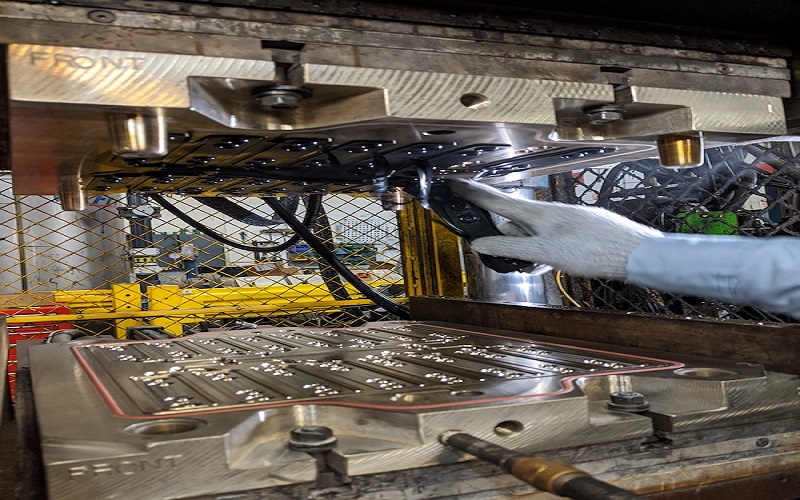
EPDM injection molding is a rubber manufacturing process that forms ethylene propylene diene monomer (EPDM) compound into components by injecting it into a closed, heated mold. The mold gives the compound its final shape, while heat and pressure cure it through vulcanization.
Unlike thermoplastic molding, the rubber does not simply melt and solidify as it cools; curing creates cross-links in the material, helping the finished part retain its shape and elastic properties.
This process is especially useful for high-volume production of intricate geometries, such as seals, gaskets, grommets, and vibration-control components.
The process is not suitable for every material or service environment. EPDM has limited resistance to petroleum-based oils and fuels, so the compound should be selected according to the chemicals, temperatures, and mechanical loads the part will encounter.
EPDM Injection Molding Process
EPDM injection molding converts a prepared rubber compound into precise, durable components by injecting it into a heated mold and curing it under controlled conditions.
1. Compound Preparation And Mixing
The process begins with the selection of a base material and formulation matched to the application. EPDM polymer is combined with fillers, processing oils, pigments, and curing agents.
The mixing process must distribute these ingredients evenly so the rubber flows consistently and develops the required mechanical properties after curing.
Formulation choices affect hardness, flexibility, heat resistance, weatherability, and the final product’s performance in service.
2. Feeding and Plasticizing
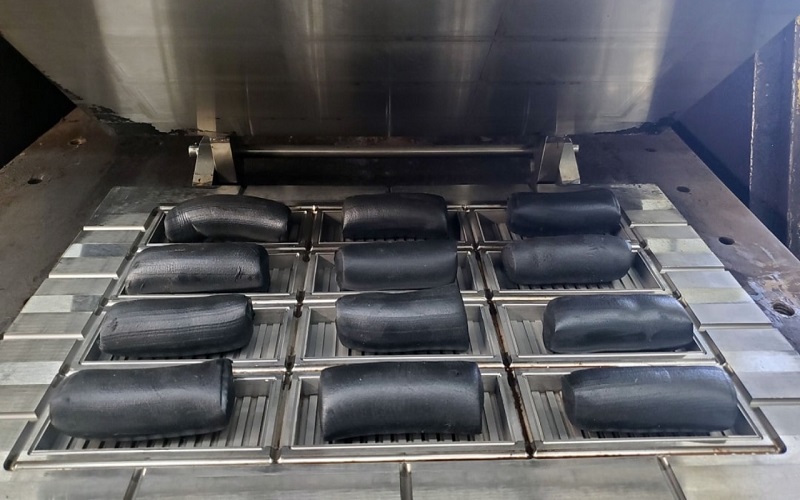
The prepared compound is loaded into the molding machine’s feed system. A screw inside the heated barrel conveys and conditions the rubber before injection. As the screw rotates, it moves the compound forward and prepares a measured shot for the mold.
Unlike thermoplastics, EPDM is not simply melted and cooled: barrel heat is carefully controlled to maintain suitable flow while preventing premature curing.
3. Injection and Mold Filling
The machine injects the conditioned EPDM compound into a closed mold cavity under pressure. Precise control of injection speed, pressure, and shot size helps the material fill the cavity and reproduce the desired profile.
Mold design, venting, and gate placement also influence flow and help limit trapped air, short shots, and flash. Tight tolerances may be important for parts such as automotive weather stripping, door seals, and window seals, where a reliable fit supports sealing performance.
4. Vulcanization and Curing
Once the cavity is filled, heat and pressure are maintained to vulcanize the EPDM. Vulcanization is a chemical process in which curing agents, usually sulfur or a peroxide system, create cross-links between polymer chains. This network gives the cured rubber its elasticity, strength, and resistance to weathering.
EPDM injection molding commonly uses mold temperatures in the range of 160°C to 200°C, although the specific temperature and cure time depend on compound formulation, part thickness, and tooling.
5. Demolding and Finishing
After curing, the mold opens and the component is removed. Operators or automated equipment may trim excess material, remove flash, and check that details and edges are intact.
Depending on the application, further processing can include surface treatments, assembly, or packaging. Consistent handling helps protect the part’s surface finish and dimensions.
This manufacturing process is well suited to high-volume production of intricate geometries, including seals and gaskets with ribs, grooves, or other detailed features.
Compared with some thermoplastic molding operations, EPDM typically requires longer cycle times because the rubber must vulcanize before the part can be removed.
EPDM Extrusion Process Vs EPDM Injection Molding
EPDM extrusion and EPDM injection molding both shape uncured rubber before vulcanization, but they suit different part designs and production needs. Understanding each production process helps manufacturers choose an efficient method while maintaining product quality.
Extrusion Process Of EPDM Rubber
In EPDM extrusion, unvulcanized rubber is pushed through a shaped die to create continuous profiles with a consistent cross-section, such as strips, tubes, and seals. These products are cured in a continuous vulcanization line and cut to length.
Extrusion suits long, uniform parts, including hoses, roofing membranes, and building seals. Reinforcement layers can be added to hoses for extra strength or pressure resistance.
Injection Molding Process Of EPDM Rubber
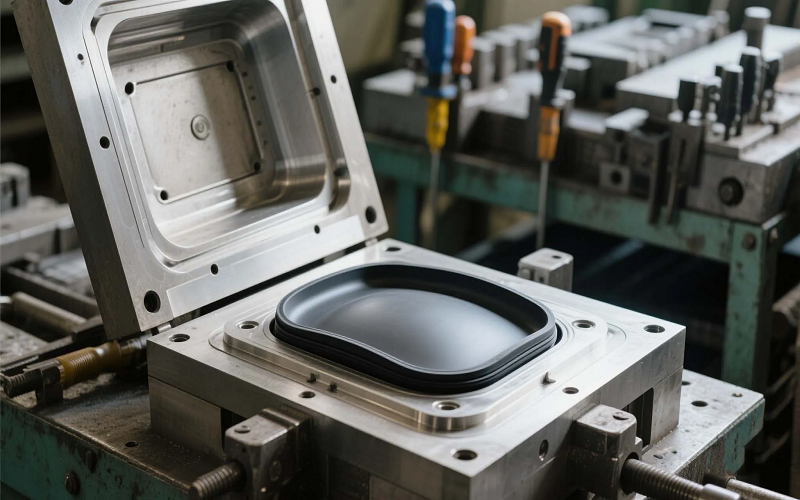
EPDM injection molding injects pre-compounded rubber into a heated, closed mold, where heat and pressure cure it. The finished part is then removed, trimmed, and inspected.
It is well suited to high-volume production of complex, three-dimensional parts such as seals, retainers, and gaskets with ribs, grooves, or mounting features.
Although curing makes cycles longer than thermoplastic molding, automation helps ensure efficient, consistent production.
Key Differences
The main difference between the two processes lies in the geometry of the finished product: extrusion produces continuous profiles with a uniform cross-section, while injection molding makes individual components with complex three-dimensional geometries.
Extrusion tooling centers on the profile die and subsequent vulcanization line; injection molding requires a mold designed around the complete part and the details of its cavity.
For long seals or hoses with a uniform cross-section and production that can be organized as a continuous process, consider extrusion. For components with complex geometries, integrated features, or strict dimensional consistency in high-volume production, consider injection molding.
Both processes require careful control of the compound formulation and vulcanization. Manufacturers should check part dimensions, cure uniformity, and surface condition, and use visual inspections to identify surface defects such as bubbles, cracks, or incomplete filling. Testing should be selected according to the application and relevant industry standards.
| Comparison dimension | EPDM Extrusion | EPDM Injection Molding |
|---|---|---|
| Process principle | Uncured rubber is continuously pushed through a die, then vulcanized to set its shape. | Uncured rubber is heated and injected under high pressure into a closed mold, where it is vulcanized. |
| Product form | Continuous, uniform-cross-section profiles (2D cross-sections) | Separate, complex three-dimensional parts |
| Typical products | Door and window seals, automotive seals, hoses, D- and P-shaped seals, and edge trim | Gaskets, custom-shaped seals, vibration-damping pads, boots, and parts with metal inserts |
| Tooling cost | Low (die costs are generally lower) | High (precision molds cost significantly more) |
| Dimensional accuracy | Moderate (affected by extrusion swell and vulcanization shrinkage) | High (tighter tolerances can be achieved) |
| Production efficiency | Continuous production, suited to high-volume runs of long profiles | Batch production, suited to medium- and high-volume runs of complex parts |
| Material utilization | High, with little flash | High due to precise metering, although the runner system generates scrap |
| Shape complexity | Limited to uniform cross-sections and straight or coiled profiles | Can form complex geometries, variable wall thicknesses, holes, and parts with inserts |
Applications Of Injection Molded EPDM Rubber Products
Injection molded EPDM rubber products serve industries that need durable, flexible components with reliable sealing and cushioning performance.
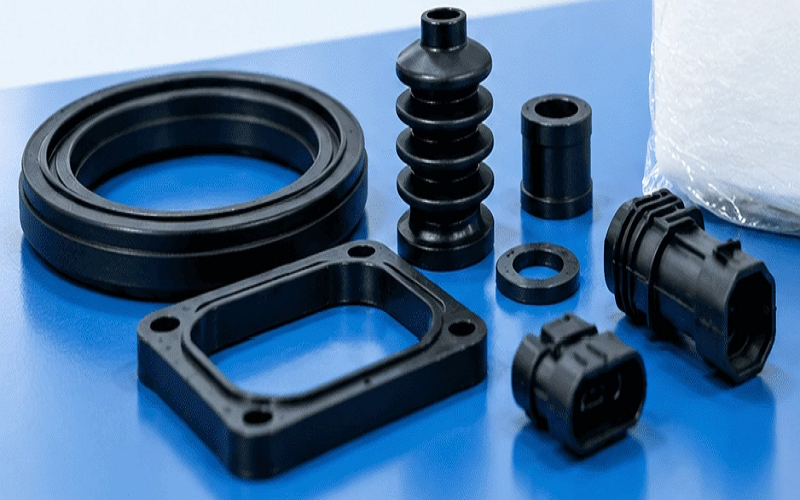
The process can produce intricate geometries in repeatable dimensions, making it well suited to high-volume parts with ribs, grooves, holes, or integrated mounting features.
EPDM’s resistance to weathering, ozone, water, and temperature changes supports use in both indoor and outdoor industrial applications, including extreme conditions.
- Automotive Seals And Components:Automotive manufacturers use injection molded EPDM for door, window, trunk, and hatch seals. These parts help block water, dust, noise, and air while staying flexible through repeated use and temperature changes.
- HVAC And Building Systems:In heating, ventilation, and air-conditioning systems, molded EPDM parts provide insulation and sealing around ducts, housings, access panels, and other equipment.EPDM is also widely used in roofing membranes because of its durability and resistance to weather and UV exposure.
- Industrial And Chemical Equipment:Industrial equipment uses molded EPDM seals, gaskets, boots, and protective parts to help keep out water, dust, and environmental contaminants. For chemical-industry fluid handling, EPDM hoses are commonly used to transport certain corrosive materials. The curing process for EPDM hoses occurs at 150°C to 200°C.
- Electrical And General-Purpose Products:EPDM’s electrical insulation properties make it useful in molded covers, boots, grommets, and protective components around electrical equipment. Injection molding also supports custom bumpers, pads, caps, and other resilient components used in equipment, appliances, and infrastructure.
Across these applications, manufacturers should define the operating temperature, mechanical loads, exposure to chemicals, dimensional tolerances, and expected service life before choosing a compound and mold design.
This planning helps enhance product reliability and ensures that injection molded EPDM is used where its durability, flexibility, and processing advantages provide a practical fit.
Advantages And Limitations Of EPDM Injection Molding
EPDM injection molding offers manufacturers a practical way to produce durable rubber parts with detailed shapes and consistent dimensions.
Its benefits are strongest when the design, compound, and production volume are well matched to the process. As with any manufacturing method, however, tooling costs, curing requirements, and material compatibility should be considered before production begins.
Advantages Of EPDM Injection Molding
- Consistent dimensions in high-volume production : A well-designed mold and stable process settings help produce components with repeatable dimensions. This consistency supports reliable assembly and sealing performance, particularly in the automotive industry, where parts such as weather strips and seals must fit accurately.
- Efficient material use: Compared with processes that require extensive shaping or assembly, injection molding can also reduce secondary operations for parts formed in one cycle.
- Lower material costs and reduced environmental impact : EPDM generally costs less than high-performance elastomers and is produced using fewer harmful chemicals than many other rubbers.
- Durable performance across demanding conditions: EPDM has strong resistance to ozone, weathering, water, and aging. Depending on the compound, EPDM products can retain performance across temperatures ranging from about -40°C to 150°C, making them suitable for outdoor use and extreme temperatures. Its electrical insulation properties also support applications such as protective covers and insulating components.
- Automation potential: Injection molding machines can automate material feeding, mold closing, curing cycles, and part ejection. Automation helps manufacturers maintain repeatable output and supports quality control in large production runs across various industries.
Limitations Of EPDM Injection Molding
The process is not suitable for every material or service environment. EPDM has limited resistance to petroleum-based oils and fuels, so the compound should be selected according to the chemicals, temperatures, and mechanical loads the part will encounter.
Once cured, EPDM cannot be remelted or recycled like thermoplastics.Manufacturers also need to account for the cost of tooling and the longer cycle times associated with vulcanization.
Overall, EPDM injection molding is a strong option when a project needs complex rubber components, repeatable dimensions, and dependable performance under outdoor or industrial conditions.
A comparison of expected production volume, tooling expense, geometry, and chemical exposure helps determine whether injection molding is the right choice.
Conclusion
EPDM injection molding is an effective way to produce durable, dimensionally consistent rubber components with complex geometries at high volumes.
By controlling compound preparation, injection conditions, mold design, and vulcanization, manufacturers can create reliable seals, gaskets, and other parts for automotive, HVAC, construction, and industrial applications.
The best results come from matching the EPDM formulation and process to the part’s operating conditions, including temperature, mechanical loads, and chemical exposure.
While tooling costs and longer curing cycles should be considered, injection molding offers repeatable quality, reduced material waste, and strong automation potential. Careful testing against relevant quality standards helps ensure the finished components meet performance requirements.