
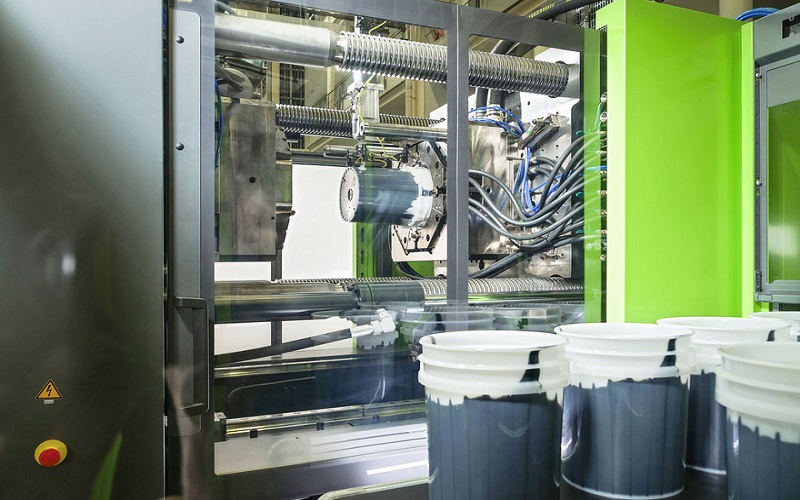
As demand for sustainable manufacturing continues to grow, recycled plastic injection molding is becoming an important way to reduce plastic waste and reliance on virgin raw materials.
It turns recycled plastics that have been sorted, cleaned, and reprocessed into new plastic parts, returning materials to the production cycle.
This article explains the fundamentals, production process, benefits, and challenges of recycled plastic injection molding. It also outlines how manufacturers can use material testing and process adjustments to improve resource efficiency while meeting product quality requirements.
What Is Recycled Plastic Injection Molding?
Recycled plastic injection molding is a manufacturing process that uses recycled materials to produce new plastic parts.
Instead of relying entirely on virgin material, manufacturers prepare recovered plastic—often from packaging, bottles, or factory-floor scrap—and feed the processed resin into injection molding machines.
The molding process heats the resin until it melts, injects it under pressure into a mold, and cools it into a finished component.
With careful design, process control, and quality checks, recycled plastics can produce durable parts with consistent dimensions and performance comparable to parts made with virgin materials.
Sources Of Recycled Materials
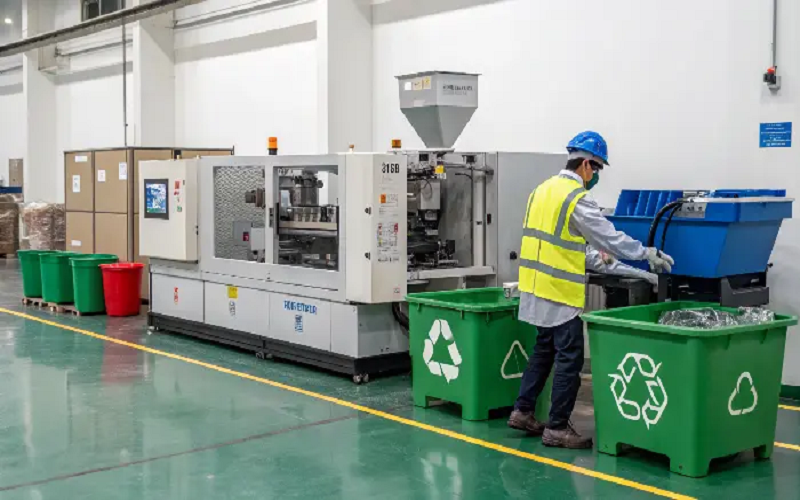
Recycled plastic used in injection molding generally comes from two sources: post-industrial scrap and post-consumer plastic.
Post-industrial recycled material (PIR)
It is recovered from factory operations, including sprues, runners, rejected parts, and excess material from production. Because this scrap is collected before it reaches consumers, it is often easier to identify and sort.
Clean, compatible scrap can be shredded and fed directly back into the production line, helping manufacturers reuse material and reduce landfill waste.
Post-consumer recycled plastic (PCR)
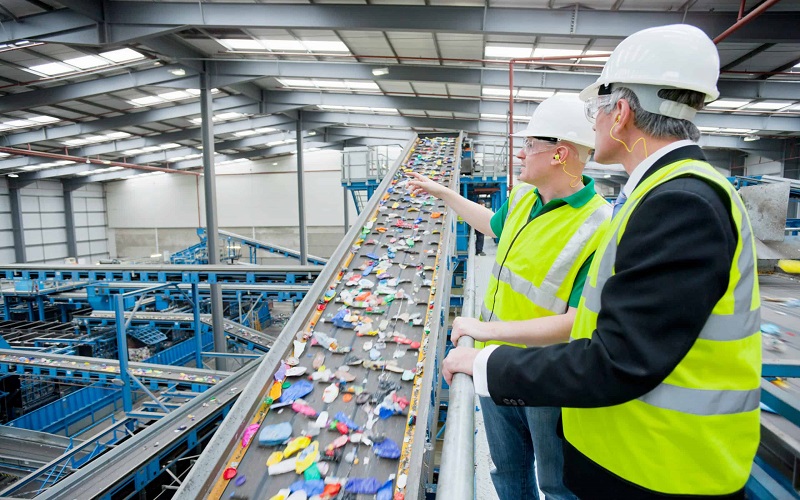
PCR comes from products that consumers have used and placed into recycling systems, such as bottles, packaging, and household goods. It must typically be collected, sorted by polymer and color, cleaned, and reprocessed into flakes or pellets before full production.
This entire process can turn discarded plastic into new products and support plastics recycling and a circular economy, but its success depends on reliable suppliers and careful material preparation.
Due to the demand for processing and processing, high-quality PCR materials can be produced and are equivalent to raw materials.
The quality of either stream depends on its composition and history. Different polymers should not be mixed without testing, and contamination from labels, food residue, metals, or other plastics can compromise the material’s properties and the durability of molded parts.
Repeated heating can also cause a drop in melt flow or strength, so manufacturers test incoming batches and may use additives or blend recycled resin with virgin plastic. These checks help ensure that material is suitable for the part, whether it is used at small or large scale.
Common Types of Recyclable Plastics
Common recyclable plastics used in recycled plastic injection molding include the following materials, ranked by how widely they are used and how well-established their recycling systems are:
1. PP (Polypropylene)
- Recycling code: 5
- Properties: Low density, good chemical resistance, and relatively good heat resistance. PP is one of the most widely used materials in recycled injection molding.
- Common sources: Food containers, bottle caps, automotive bumpers, appliance components, and reusable crates.
- Applications after recycling: Automotive interiors, appliance housings, household goods, logistics crates, and furniture.
2. PE (Polyethylene)
PE is generally divided into two types:
- HDPE (High-Density Polyethylene), recycling code: 2
- Common sources: Milk bottles, laundry detergent bottles, plastic buckets, and pipes.
- Suitable recycled applications: Bottle caps, reusable crates, pipes, and boards.
- LDPE (Low-Density Polyethylene), recycling code: 4
- Common sources: Plastic bags, films, and flexible packaging.
- Recycled LDPE is often used in films and pipes, and can also be modified for injection molding.
3. PET (Polyethylene Terephthalate)
- Recycling code: 1
- Properties: High transparency and good strength. PET is one of the most widely recycled plastics.
- Common sources: Mineral water bottles, beverage bottles, and food packaging.
- Applications after recycling: Recycled PET is more commonly turned into fiber, but it can also be modified for injection molding, such as for packaging containers and sheets.
4. ABS (Acrylonitrile Butadiene Styrene)
- Properties: Good overall mechanical performance and a high-gloss surface. ABS is one of the more commonly recycled engineering plastics.
- Common sources: Appliance housings, electronic product enclosures, automotive interior components, and toys.
- Applications after recycling: Appliance structural parts, automotive components, and office equipment housings.
5. PS (Polystyrene)
- Recycling code: 6
- Types: General-purpose PS and expanded PS (EPS).
- Common sources: Disposable tableware, packaging boxes, and protective packaging for electronic products.
- Applications after recycling: Applications are relatively limited; recycled PS is mainly used in injection-molded products with less demanding requirements or in modified materials.
| Material | Recycling Difficulty | Recycled Injection Molding Maturity | Main Limitations |
|---|---|---|---|
| PP | Low | Very high | Batch consistency |
| HDPE | Low | High | Color and contamination control |
| PET | Moderate | Medium-high | Requires thorough drying; mainly used for fibers |
| ABS | Moderate | Relatively high | Reduced impact resistance |
| PS | High | Moderate | Brittle; limited applications |
The Complete Recycled Plastic Injection Molding Process
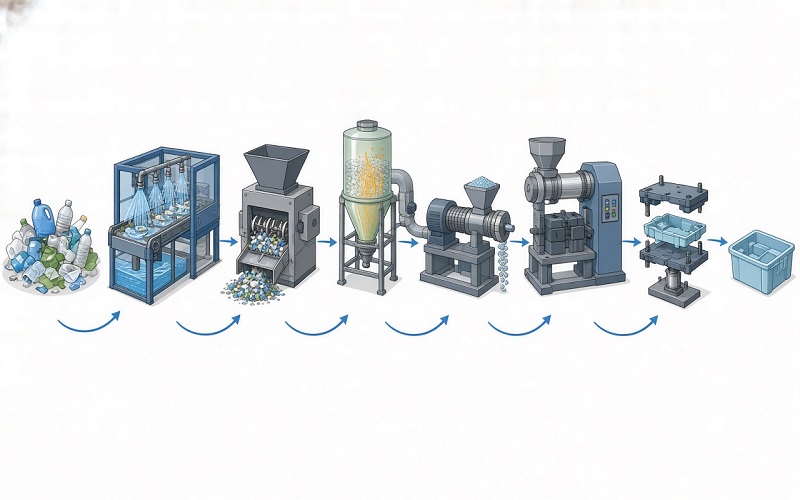
Recycled plastic injection molding typically involves sorting and preparing recycled materials, blending, melting and plasticizing, injection molding, cooling and ejection, and final product inspection.
Each step affects material consistency, product quality, and production efficiency, so process parameters should be selected based on the plastic type, material source, and part requirements.
1. Sorting and Classifying Recycled Materials
First, verify the source, polymer type, and batch information of the recycled plastic, then sort it by material, color, and intended use. Different resins may have different melting temperatures and flow characteristics, so they should not be mixed without validation.
Supplier material certificates and traceability records can also help confirm that recycled resin meets product requirements and sustainability standards.
2. Washing, Shredding, and Drying
Recycled material containing labels, oil, food residue, or other contaminants should first be sorted and washed, then processed into uniformly sized flakes or pellets using shredding equipment.
Next, dry the material according to the resin’s moisture sensitivity to reduce bubbles, silver streaks, and performance fluctuations. Contaminants can weaken the structural integrity of parts, so inspect the material before it enters the injection molding machine.
3. Blending and Material Adjustment
Depending on the part’s strength, appearance, and dimensional requirements, manufacturers can use recycled resin alone or blend it with virgin resin.
For some applications, a 75:25 virgin-to-recycled ratio can serve as a starting point for trials, but the final blend must be determined through material testing and mold trials.
Melt flow and mechanical properties may vary between batches; stabilizers and other additives can be used when needed to help recover or maintain material performance.
4. Melting, Plasticizing, and Injection
Dried resin is fed into the hopper, then heated in the barrel and conveyed, compressed, and plasticized by the screw. Once the melt reaches the appropriate condition, the injection unit delivers it into the mold cavity at the specified speed and pressure.
Because recycled resin may have a different thermal history and flow behavior than virgin resin, operators often adjust barrel temperature, screw speed, back pressure, injection speed, and holding time. Trial production helps confirm a stable processing window.
5. Cooling, Ejection, and Trimming
After the plastic cools and solidifies in the mold, the mold opens and the ejection system releases the part. Cooling time, mold temperature, and holding conditions can affect shrinkage, warpage, and dimensional accuracy. Gates and flash can be trimmed after ejection.
Clean sprues and runners that meet process requirements can also be recycled and reused once material compatibility has been confirmed.
6. Quality Inspection and Closed-Loop Improvement
Inspect finished parts for appearance, dimensions, weight, and any required mechanical properties, while recording material batch details and processing parameters.
If short shots, bubbles, discoloration, or dimensional deviations occur, investigate moisture content, contamination, material ratios, temperature, and injection pressure.
Reintroducing suitable production scrap into the process reduces waste and creates a more efficient closed loop. Through ongoing inspection and process optimization, manufacturers can control costs while maintaining consistent product quality.
Key Benefits Of Using Recycled Plastic For Injection Molding
Using recycled plastic in injection molding can help manufacturers reduce waste, conserve resources, and meet growing demand for more sustainable products.
When materials are properly sorted, prepared, and tested, recycled resin can produce durable parts while supporting efficient, responsible production.
Reduced Environmental Impact
Compared with virgin resin, recycled plastic requires less energy to produce and generates fewer carbon emissions.
Producing 1 kilogram of virgin plastic emits approximately 2 to 3 kilograms of carbon dioxide, while recycled plastic emits about 0.8 to 1.2 kilograms—a reduction of up to 60%.The IMK2 machine uses only 0.2 kW/h for recycling.
Recycling also helps reduce the amount of plastic waste sent to landfills, conserve resources, and support a circular economy by extending the useful life of materials.
Cost Potential
Recycled resin can be cheaper than virgin material, particularly when manufacturers reuse clean post-industrial scrap. Lower raw-material costs may improve production economics, while recycling in-house can reduce the amount of new resin a facility needs to purchase.
However, recycled plastic is not always the lower-cost option. High-quality PCR can cost as much as virgin grades because collection, sorting, cleaning, testing, and traceability add expense. Prices can also shift quickly relative to virgin resin.
Durable Parts and Flexible Material Choices
With suitable material selection and process control, recycled plastics can produce long-lasting parts with tight tolerances and durability comparable to virgin materials.
Manufacturers can use recycled resin on its own for appropriate applications or blend it with virgin plastic to achieve the desired properties. A 75:25 virgin-to-recycled ratio may be a starting point for trials, although the right blend depends on the resin, design, and performance requirements.
This flexibility allows high recycled content to be considered for a wide range of products, from housings and brackets to packaging and other components.
Better Sustainability and Customer Appeal
Certified recycled materials can help brands meet sustainability standards and show progress toward their environmental goals. Using recycled plastic also reduces the need for new plastic and can improve a company’s sustainability record.
Many consumers care about the environment and prefer brands that work to reduce waste. Recycled plastic can help a company build trust and meet customer expectations, as long as its sourcing and sustainability claims are accurate and well documented.
Efficient Use of Production Scrap
Injection molding is highly efficient, and recycling suitable production scrap makes it more so. Manufacturers can recover clean factory-floor material, reprocess it, and return it to production rather than sending it to landfill.
Some operations reuse over 97% of post-industrial scrap, showing how process design and recycling technology can help reduce material losses.
These benefits depend on consistent feedstock and sound quality control. Material testing, supplier verification, and appropriate equipment adjustments help manufacturers maintain product quality while capturing the environmental and cost advantages of recycled plastic injection molding.
Challenges of Recycled Plastic Injection Molding
Although recycled plastic injection molding helps reduce waste and raw material consumption, manufacturers may still face challenges during production.
- Contamination and Color Drift: Recycled plastics from different sources can vary in composition, color, melt flow, and mechanical properties. Repeated heating may also affect material strength. If the feedstock contains metal, labels, or other plastics, contaminants can compromise the structural integrity of finished parts.
- Narrower Process Window: The melt flow index, viscosity, and thermal stability of recycled resin can vary with its source and recycling history. Using the same settings as for virgin material may lead to short shots, flash, bubbles, sink marks, or warpage.
- Shifts in Melt Flow and Viscosity: Repeated heating and shear can degrade polymer chains and alter the melt flow rate (MFI), narrowing the processing window. Manufacturers can select suitable stabilizers or blend recycled resin with virgin plastic to meet product performance requirements. The appropriate ratio should be determined through testing.
To maintain product quality, manufacturers need to sort, wash, and dry incoming material and test each batch. They should also adjust molding temperature, pressure, and speed according to the material’s properties. Stabilizers or virgin plastic can be added when necessary.
With ongoing testing and process optimization, companies can identify and address quality fluctuations promptly, take appropriate steps to protect product quality, and use recycled materials reliably in production.
Conclusion
Recycled plastic injection molding helps reduce plastic waste and reliance on virgin materials while meeting product quality and sustainability requirements.
To address material variability and processing challenges, manufacturers can find effective solutions through rigorous sorting, testing, and process optimization.
As technology continues to advance, this manufacturing approach is expected to develop further, creating more opportunities for plastic recycling and sustainable production.