
If you’ve ever held a plastic bottle, a shampoo container, or a pharmaceutical vial, you’ve already seen the results of blow molding in action.
But not all blow molding is the same — and if you’re trying to decide between extrusion blow moulding vs injection blow moulding for your next project, understanding the key difference between these two processes is crucial.
These are two distinct manufacturing processes with different strengths, different limitations, and very different economics depending on what you’re trying to make. This guide breaks down everything you need to know so you can pick the right process from the start.
What Is Blow Molding?
Before diving into the comparison, it helps to understand what blow molding actually is.
At its core, the blow molding process is a manufacturing method designed specifically for producing hollow plastic parts — things like plastic bottles, containers, fuel tanks, and other hollow shapes that can’t be made with standard injection molding alone.
The basic idea behind every blow molding process is the same: softening plastic until it’s pliable, forming it into a rough shape, and then using compressed air to inflate that shape against the walls of a water cooled metal mold until it takes the final shape required.
What makes extrusion and injection blow molding different is how they get the plastic to that intermediate stage before the air goes in. That principal difference — how the melted plastic is prepared and delivered to the mold — is what drives all the downstream differences in cost, precision, complexity, and material options.
What Is Extrusion Blow Moulding?
Extrusion blow molding, often shortened to EBM, is the older and more widely used of the two processes.
It’s a continuous method where plastic pellets are fed into an extruder, melted down, and pushed through a die by a rotating screw. The screw can turn continuously or intermittently; when it turns continuously, it ensures a steady flow of molten plastic, which can improve consistency in the extrusion process.
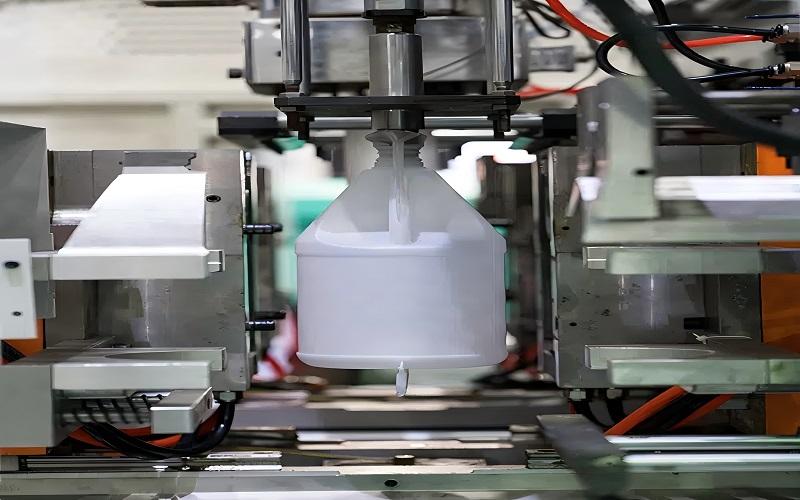
The result is a hollow tube of molten polymer called a parison — a soft, tube-like piece of heated material that hangs down from the die.
Once the parison reaches the right length, the two half forms of the mold close around it.
In EBM, compressed air is then blown in through the top, inflating the parison outward until it presses against every surface of the water cooled metal mold. In contrast, in injection blow molding (IBM), the preform is inflated and cooled after being injected into the mold.
The plastic must be cooled sufficiently before the mold opens and the finished product is ejected to ensure proper mold release and part integrity. Any excess plastic — known as flash — at the top and bottom of the part gets trimmed off, which is one of the key trade-offs with this process.
Extrusion blow molding (EBM) involves extruding melted plastic into a hollow tube called a parison, while injection blow molding (IBM) involves injecting melted plastic into a mold using a core pin.
The Accumulator Method in EBM
For larger parts or thicker walls, a variation called the accumulator method is often used.
In this approach, an accumulator gathers melted plastic until enough plastic has built up to form the parison in a single, rapid shot.
This is especially useful when producing large containers like fuel tanks or industrial drums, where a continuous extrusion wouldn’t deliver the material fast enough or consistently enough to form the part correctly.
Materials Used in Extrusion Blow Molding
EBM processes a wide range of materials, including HDPE, LDPE, PVC, and PP. Extrusion blow molding is most commonly used to form products out of high-density polyethylene (HDPE), polypropylene (PP), and polyethylene terephthalate (PET).
These materials offer a good combination of flexibility, chemical resistance, and processability that suits the extrusion process well.
Common materials used in blow molding include polyethylene (HDPE, LDPE), polypropylene, PET, and PVC, each offering different benefits depending on the application.
What Is Injection Blow Moulding?
Injection blow molding — the IBM process — takes a fundamentally different approach.
Rather than extruding a continuous hollow tube, injection blow molding starts by injecting melted plastic into a mold using a core pin, or core rod, to form a preform.
Think of this preform as a small, thick-walled test-tube shape that already has the neck finish of the final container molded in precisely. The IBM process enables total control over key aspects like neck finishes and material distribution, ensuring high-quality, scrap-free bottles. The preform is then transferred — still on the core rod — to a blow mold, where compressed air inflates it outward into the final shape of the bottle or container.
This two-stage approach — injection first, then blowing — is what gives the IBM process its distinctive characteristics and allows it to produce large volumes of quality parts efficiently.
Because the neck and opening of the container are already formed during injection, they come out with a high precision match between both halves of the mold and extremely consistent dimensions.
That’s critical for containers that need to accept a cap, a closure, or a dispensing mechanism with no tolerance for variation.
How the IBM Process Works in Practice
In the IBM process, the molten polymer is first injected around the core rod inside a preform mold, creating a precise, uniform preform in a liquid state.
Once the preform has cooled enough to hold its shape, the core rod carries it to the blow station, where air inflates the heated material outward to fill the blow mold.
After blowing and cooling, the core rod moves to an ejection station and the finished product is released.
EBM is generally a one-step process, while IBM involves multiple stages of injection, blowing, and ejection — which adds complexity but also adds control.
One of the most significant advantages of the IBM process is that it produces no flash and no scrap.
Injection blow molding is a scrap-free process, meaning that bottles produced require no trimming operation, which can lead to cost savings in material waste.
That’s a real operational advantage over EBM, particularly at high production volumes.
Materials Used in Injection Blow Molding
Injection blow molding is most commonly used to form products out of acrylic, polycarbonate, polyoxymethylene (POM), and polyethylene (PE).
The range also includes acrylic polycarbonate polyoxymethylene blends, and the process works well with any thermoplastic that can be injection molded into a precise preform.
Material selection for injection blow material tends to be guided by the precision requirements of the final application — medical and research applications, for instance, often call for materials with very specific chemical or optical properties that injection blow molding can accommodate.
Extrusion Blow Moulding vs Injection Blow Moulding: Key Differences
Now that both processes are clear, let’s walk through the key differences that actually matter when you’re making a manufacturing decision.
These two different manufacturing processes diverge significantly across design complexity, tooling costs, production volume, waste, and the types of parts each one handles best.
Design Complexity and Shape Capability
EBM allows for more complex shapes, including handles, while IBM is limited to simpler shapes with superior precision for neck finishes. That’s the clearest summary of how design complexity plays out between the two processes.
Because the parison in extrusion blow molding is a free-formed hollow tube that gets inflated against the mold, designers have a lot of freedom in the overall geometry of the container.
Extrusion blow molding can manufacture complex shapes due to the way the product is formed, making it suitable for a variety of applications including automotive ducts and household products.
Bottles with integrated handles, asymmetric containers, and non-round cross-sections are all achievable with EBM in ways that IBM simply can’t replicate.
IBM, on the other hand, produces smaller containers with simpler wall shape but exceptional precision at the neck.
The core rod controls the inner dimensions of the preform with great accuracy, making wall thickness consistent and the neck finish dimensionally exact.
This makes IBM ideal for producing smaller containers where a high precision match between the preform and the blow mold is essential.
Wall Thickness and Part Precision
Wall thickness is one area where the two processes feature unique functions that suit different applications.
In extrusion blow molding, controlling wall thickness can be difficult because the parison stretches unevenly as it inflates — thinner areas develop wherever the plastic stretches most.
Modern EBM machines use parison programming to vary wall thickness along the length of the tube, but achieving perfectly uniform walls across complex shapes remains challenging.
Wall thickness difficult to control precisely is one of the acknowledged limitations of the EBM approach.
Injection blow molding is advantageous for producing small containers with high accuracy and uniform material distribution, making it suitable for medical and single-serve products.
Because the preform is injection molded with controlled wall dimensions before blowing, the final part inherits that consistency throughout.
For applications where uniform wall thickness is non-negotiable — medical devices, precision cosmetic packaging, single serve bottles — IBM delivers results that extrusion blow molding can’t match.
Tooling Costs
EBM typically has lower tooling costs compared to IBM, which requires two sets of molds — a preform mold and a blow mold. This is a meaningful difference, especially in the early stages of a project.
With EBM, you need a single set of blow molds and a die to form the parison — both relatively straightforward pieces of tooling.
With IBM, you need a precisely matched preform mold and a separate blow mold, and the preform mold in particular needs to be machined to tight tolerances to ensure the core pin and core rod seat correctly.
Extrusion blow molding offers low initial mold tooling costs and design flexibility, allowing for a wide range of container shapes and sizes, but it may result in higher unit costs for smaller containers due to the trimming and flash reclaim that the process generates.
IBM’s higher tooling investment tends to pay off at high production volumes where the scrap-free nature of the process and the consistency of the output reduce per-part costs over time.
Production Volume and Efficiency
Both processes can produce large quantities of parts, but they scale differently.
EBM is well-suited for large, complex containers and can produce large volumes efficiently when running multi-cavity tooling for simpler bottle shapes.
Its continuous method lends itself to high-throughput production lines for products like HDPE jugs, fuel tanks, and household chemical containers.
IBM is designed to produce large volumes of small, precise containers very efficiently.
The IBM process is most competitive when producing smaller containers such as single-serve bottles and medical devices, due to its ability to create precise and uniform wall thicknesses.
The scrap-free nature of IBM also means that material efficiency improves as volumes climb — you’re not paying to reclaim and regrind flash on every cycle.
Waste and Scrap
This is a genuinely important operational difference. Extrusion blow molding typically generates scrap in the form of flash and trim, which must be trimmed and reclaimed, increasing production costs.
Every part that comes off an EBM line needs to have its pinch-off flash removed, and the excess plastic from the previous mold cycle needs to be reprocessed.
Over a high-volume production run, that waste adds up in both material cost and labour time.
IBM produces no flash and no trim waste at all. The preform is injected to the exact right amount of material, and the blow step simply expands that into the final shape.
For recyclable plastic parts and applications where material efficiency matters — medical devices, premium cosmetics, food-grade packaging — that zero-waste characteristic of IBM is a genuine advantage.

Injection Stretch Blow Molding: A Third Option
It’s worth addressing injection stretch blow molding here, because it often comes up alongside these two processes and causes confusion.
Injection stretch blow molding — sometimes called ISBM or stretch blow molding — combines the preform injection stage of IBM with an additional stretch step.
A stretch rod extends into the preform and physically stretches it longitudinally before compressed air inflates it radially.
Injection stretch methods form containers with biaxially oriented plastic, which dramatically improves clarity, barrier properties, and strength.
Injection stretch blow molding is the process behind most PET bottles — including the polyethylene terephthalate bottles used for water, carbonated drinks, and edible oils.
Injection stretch methods are especially effective with PET because the biaxial orientation of the molecular chains in PET improves mechanical performance significantly.
Straight extrusion blow molding can’t achieve this level of molecular orientation, and standard IBM doesn’t stretch the preform in the same way.
If you’re working with PET and need the optical clarity and barrier performance typical of consumer beverage bottles, injection stretch blow molding is the relevant process — not standard IBM or EBM.
Which Applications Suit Each Process?
EBM is ideal for large, complex containers with handles, while IBM is better for high-volume production of small-necked containers. That summary holds across most real-world applications, but let’s get more specific.
Extrusion blow molding is the dominant process for products like HDPE jugs, detergent bottles, automotive ducts, fuel tanks, industrial drums, and any hollow plastic parts that are large, need handles, or have unconventional shapes.
The combination of design flexibility, low tooling costs, and material range makes it the go-to choice for high-volume commodity packaging.
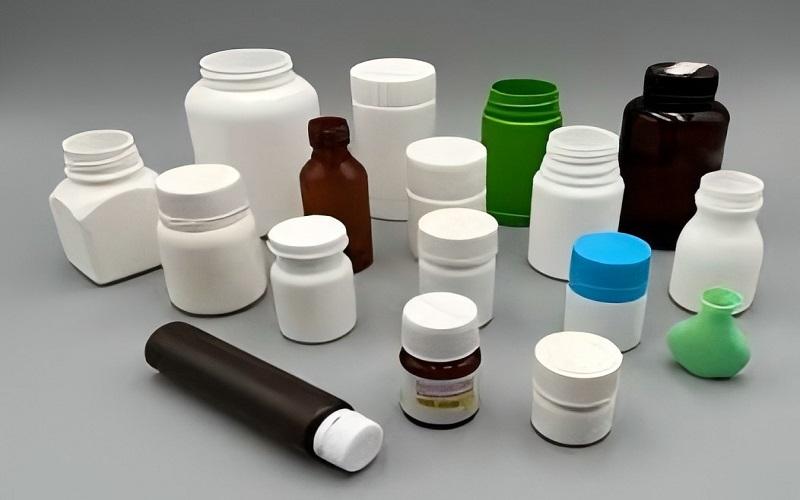
Injection blow molding is well suited for pharmaceutical vials, cosmetic jars, medical devices, and single serve bottles where precision, cleanliness, and uniformity are paramount.
EBM is well-suited for larger containers such as jugs and fuel tanks, while IBM is typically used for small pharmaceutical vials and cosmetic jars.
The scrap-free process and tight dimensional control also make IBM attractive for medical and research applications where contamination from reclaimed flash would be unacceptable.
How These Processes Compare to Injection Molding
It’s worth briefly clarifying how blow molding and injection molding relate, since the names cause confusion.
Standard injection molding — the kind used to make solid parts like housings, brackets, and electronic components — fills a closed mold cavity completely with molten polymer to form a solid part.
Blow molding, whether extrusion or injection, is specifically for hollow parts.
Injection blow molding (IBM) is typically used to form solid parts such as medical devices and kitchen components produced with injection molding, while extrusion blow molding (EBM) is used for hollow parts like bottles and containers.
The extrusion and injection steps in blow molding are preparation stages — the actual forming happens when compressed air creates the hollow shape.
Conclusion
When it comes to extrusion blow moulding vs injection blow moulding, there’s no universally better process — only the one that fits your specific part, volume, and budget requirements.
Extrusion blow molding gives you design flexibility, lower tooling costs, and the ability to handle complex shapes and large containers with a wide range of materials.
Injection blow molding gives you precision, zero waste, and consistent wall thickness that makes it indispensable for medical, pharmaceutical, and high-accuracy applications.
If you’re producing large hollow plastic parts with handles or irregular geometry, EBM is almost certainly your answer.
If you’re making small, precise containers where neck dimensions and wall uniformity are critical, IBM will deliver results that extrusion simply can’t match.
Map out your production volume, desired shape, material requirements, and tooling budget before committing — and the right process will make itself clear.