
Packaging is one of those things that nobody thinks about until it fails. A lid that doesn’t seal properly, a container that cracks under load, a design that wastes shelf space — these aren’t minor inconveniences.
They’re real costs that ripple through storage, transportation, and customer satisfaction.
That’s exactly why injection molded containers have become the default choice across so many industries.
When precision, durability, and consistency all matter, plastic injection molding delivers in ways that few other manufacturing processes can match.
This guide covers what makes injection molded containers the right choice for efficient packaging solutions, how the process works, what materials perform best, and which applications benefit most from this approach.
Why Injection Molded Containers Stand Apart?
Custom plastic containers form the ideal example of how precision manufacturing meets real-world packaging demands.
Not all plastic containers are created equal.
The manufacturing process behind a container determines its strength, its dimensional consistency, its ability to stack reliably, and how well it holds up through the rigors of a real supply chain.
Injection molded containers consistently outperform alternatives because the process itself is built for precision and repeatability at scale.
High-pressure injection molded containers offer the best strength-to-weight ratios in the industry, outperforming products made through other processes — and that’s not a marketing claim, it’s something demonstrated through in-depth comparative tests.
The combination of a well-designed mold and quality materials produces containers that are strong, durable, and capable of handling whatever a demanding packaging environment throws at them.
What the Process Makes Possible
The design possibilities for plastic containers are essentially endless with plastic injection molding.
Molded-in threads, integrated branding logos, tamper-proof lids, complex geometric shapes, airtight seals — all of these can be built directly into the container design rather than added as secondary operations.
Precision mold design is crucial here, ensuring consistency, durability, and stackability across every unit produced.
When you’re manufacturing thousands or millions of identical containers, that consistency isn’t optional — it’s the whole point.
How the Injection Molding Process Works?
Understanding the injection molding process helps explain why it produces containers of such consistent quality.
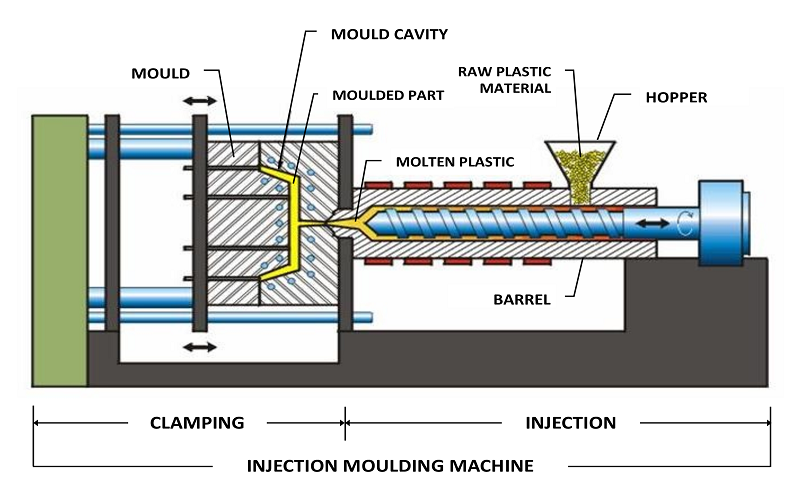
It starts with granulate — typically polypropylene or another thermoplastic resin — being fed into a cylinder with a corkscrew bolt that transports the material toward a nozzle.
The granulate is heated and transformed into a viscous plastic mass, which is then injected into the cavities of a closed tool under high pressure.
Once the cavities are filled, the container cools and solidifies inside the mold.
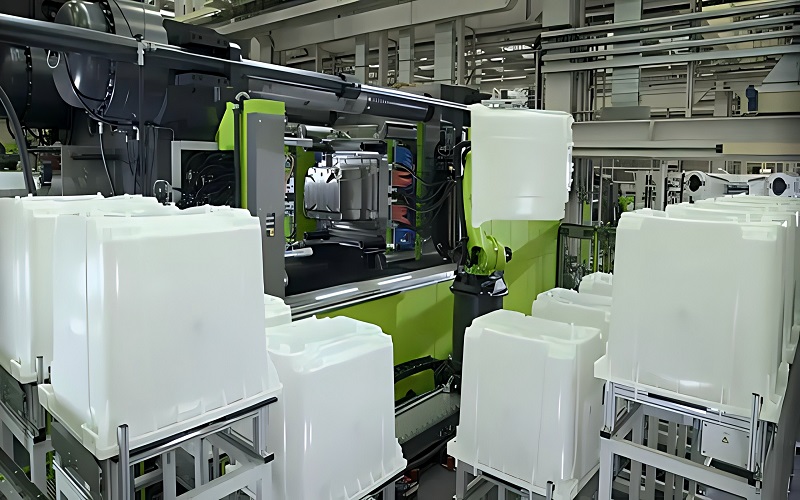
The tool then moves apart and a robot removes the finished container — a seamless, automated sequence that can complete a full cycle in as little as 10 to 50 seconds.
That speed is what makes injection molding suitable for mass production at a scale that other processes simply can’t match.
The Role of Mold Design
The mold is the heart of the entire operation.
Creating it involves close collaboration between design and tooling departments to produce a mold that is precisely the inverse of the container’s final shape.
Every feature of the finished container — its wall thickness, its lid interface, its stacking geometry — is determined by the mold.
Getting that design right upfront is critical, because changes after the mold is cut are expensive and time-consuming.
Initial tooling costs can reach tens of thousands of dollars, and the design and manufacturing of molds can take several weeks to months, which is why injection molding makes the most sense for high-volume production runs rather than small batches or one-off prototypes.
Quality Control at Every Stage
Quality control specialists ensure each final product meets the required result throughout the injection molding process.
Automated processes enhance efficiency and cost-effectiveness, but human expertise remains essential for catching dimensional variations, surface defects, and seal integrity issues before containers reach customers.
A strong quality system built around tight tolerances and documented verification is what separates manufacturers who consistently deliver quality products from those who don’t.
Materials That Make the Difference
The material used in an injection molded container is as important as the mold design.
Different applications require different combinations of strength, chemical resistance, temperature tolerance, and food safety compliance — and the right material choice affects every one of those outcomes.
Polypropylene
Polypropylene is the most commonly used material for injection molded containers, and for good reason.
It’s durable, resistant to corrosion, capable of withstanding a wide range of temperatures, and widely accepted for food contact applications.
Plastic food containers manufactured from polypropylene are designed to be reusable and have a long lifespan, making them cost-effective over time.
Polypropylene handles the demands of food and beverage packaging, personal care products, and industrial storage equally well — a versatility that makes it the starting point for most container applications.
Polystyrene and Specialty Resins
Polystyrene is another common material for injection molded containers, particularly where clarity or rigidity is the priority.
For more demanding applications — pharmaceuticals, automotive components, or containers that need to withstand harsh chemical environments — specialty resins offer combinations of thermal stability, impact resistance, and chemical compatibility that standard materials can’t provide.
Depending on the application requirements, the material selection process should always involve input from experienced engineers who understand how material properties translate into real-world container performance.
BPA-Free and Sustainable Options
High-quality plastic containers can be manufactured using BPA-free materials that meet industry safety standards — an increasingly important requirement across food, beverage, and medical packaging.
Plastic containers can also be manufactured using recycled material, contributing to a more sustainable packaging system without sacrificing the strength or durability that makes injection molded containers worth using in the first place.
Custom Plastic Containers: Designing for Specific Needs
One of the most significant advantages of injection molding is the level of customization it enables.
Custom plastic containers can be designed to precise specifications — specific sizes, shapes, wall thicknesses, lid configurations, and load-bearing requirements — all optimized for a particular application rather than adapted from a generic design.
Leak-Proof and Impact-Resistant Designs
Custom plastic containers can be designed to be leak-proof and impact-resistant for secure storage and transportation.
For industries where container failure means product loss, contamination risk, or safety issues — food processing, pharmaceuticals, chemicals — these aren’t optional features.
Injection molding expertise ensures that airtight seals and impact-resistant designs are built into the container from the ground up, not retrofitted after the fact.
Tamper-Proof and Child-Resistant Options
Plastic containers can be designed to be tamper-proof or child-resistant for enhanced security and safety.
These features are particularly important in pharmaceuticals and personal care, where regulatory requirements and customer safety demand packaging that performs reliably in the hands of end users.
Building these features directly into an injection molded container through precision mold design is far more reliable than adding them through secondary operations.
Collapsible Bulk Containers
For logistics and supply chain applications, plastic collapsible bulk containers offer a particularly compelling combination of strength and efficiency.
These containers are designed to accommodate large quantities of product and can be collapsed when not in use, saving significant storage space and reducing freight costs.
A significant benefit is that empty collapsible containers are lightweight and space-efficient to ship back — a practical advantage that reduces total cost of ownership over the container’s lifespan.
Plastic bulk containers are also reusable, have a long lifespan, can be easily repaired in the field after damage, and can be manufactured using recycled material, making them one of the more sustainable packaging solutions available for high-volume industrial use.
Industries That Rely on Injection Molded Containers
Injection molded containers are used across virtually every industry that handles, stores, or ships physical products. The combination of precision, durability, and design flexibility makes them the right solution for an enormous range of packaging requirements.
Food and Beverage
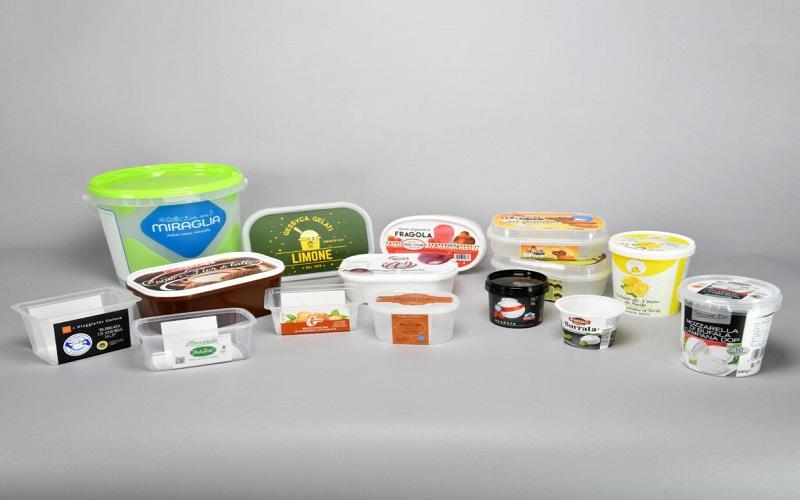
Food and beverage is the most visible application for injection molded containers.
These containers are widely used for food-safe packaging due to their resistance to heat and chemicals, their ability to be designed with secure lids and leak-proof seals, and their compliance with safety standards for food contact materials.
Plastic food containers can be produced in various sizes and shapes to meet specific storage and packaging needs — from single-serve portions to bulk storage containers used in commercial food processing.
Pharmaceuticals and Medical
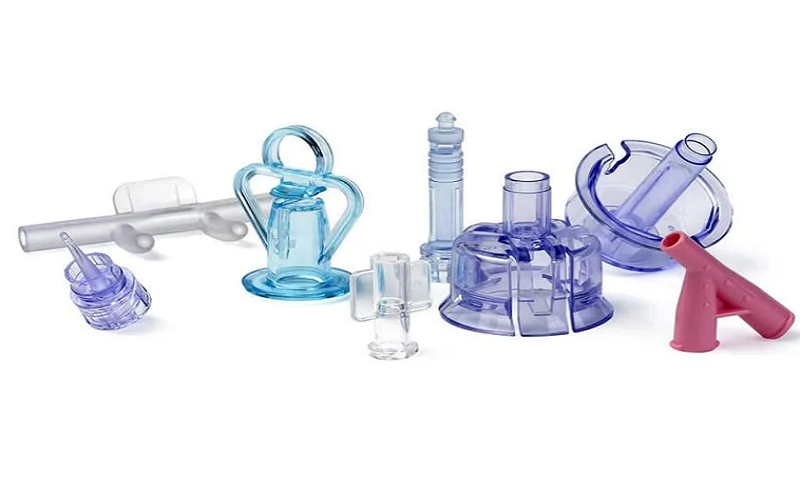
The pharmaceutical industry depends on injection molded containers for primary packaging that must meet strict regulatory requirements and maintain product integrity through storage and transportation.
Precision and consistency are non-negotiable here — every container in a production run must meet the same dimensional tolerances and performance standards.
The ability of injection molding to produce millions of identical units with the same tight tolerances is exactly what pharmaceutical packaging demands.
Automotive
Automotive applications for injection molded containers range from fluid reservoirs and storage components to specialty packaging for parts and components moving through the supply chain.
Containers designed for automotive use need to handle weight, withstand chemical exposure from oils and solvents, and maintain their structural integrity across a wide temperature range.
Polypropylene and specialty resins meet these requirements consistently, which is why the automotive industry has made injection molded containers a standard part of its packaging and storage infrastructure.
Personal Care and Consumer Products
Personal care products — shampoos, lotions, cleaning products — require containers that combine appealing design with functional durability.
Injection molding enables the complex shapes, smooth surface finishes, and precise lid interfaces that personal care packaging typically requires, all produced at the volume and consistency that consumer product companies need to serve large customer bases reliably.
The Business Case for Injection Molded Containers
For any business evaluating packaging solutions, the economics of injection molded containers need to be understood in the right context.
High production speed allows for cycle times as low as 10 to 50 seconds, making it suitable for mass production — and at that speed, the cost per unit drops to levels that other manufacturing processes can’t match for high-volume applications.
The upfront investment in tooling is real, and it means injection molding is not the right choice for small runs or one-off prototypes.
But for businesses that need large quantities of consistent, durable containers, the tooling cost amortizes quickly across production volume.
Automated processes in injection molding enhance efficiency and cost-effectiveness for both small-batch and large-scale production once the tooling is in place, and the combination of low per-unit cost, long container lifespan, and reusability creates a strong total cost of ownership compared to disposable or lower-quality alternatives.
Choosing the Right Manufacturing Partner
The quality of injection molded containers depends not just on the material and mold design, but on the expertise and capabilities of the manufacturer producing them.
A company with genuine experience in plastic injection molding — one with a skilled team of engineers, robust quality control processes, and the ability to collaborate closely with customers from initial design through production — will consistently deliver better outcomes than a commodity supplier focused purely on unit cost.
When evaluating a manufacturing partner, look at their experience across industries, their approach to mold design and tooling investment, their quality systems, and their ability to handle engineering changes and provide ongoing service after production starts.
Request detailed information about their materials sourcing, their tolerance capabilities, and how they handle quality issues when they arise.
The right partner is one who treats your container requirements as a precision engineering challenge, not just a production order to fill.
Final Thoughts
Injection molded containers have earned their place as the packaging solution of choice across food and beverage, pharmaceuticals, automotive, and consumer products because they consistently deliver what packaging needs to deliver — precision, durability, consistency, and the flexibility to be designed for almost any application.
The process produces strong, efficient, and long-lasting containers at a speed and scale that few alternatives can match.
Whether you need custom plastic containers with specialized features, high-volume standard packaging, or collapsible bulk containers built for a demanding supply chain, injection molding offers a combination of performance and economics that makes it hard to beat.