
In the sophisticated world of synthetic polymer engineering, few materials command as much industrial respect as polyethylene terephthalate (PET).
As a cornerstone of the modern plastic materials sector, the utility of this polymer is inextricably linked to its thermal characteristics, specifically the polyester melting point.
For engineers and designers, understanding at what temperature this material transitions from a solid structure to a polyester melt is not merely a technicality; it is the foundation of dimensional stability and heat resistance in the final product.
Whether it is used in food packaging or high-performance fabrics, the thermal threshold of polyester dictates its functional boundaries.
The melting point of a material like PET is a reflection of its internal molecular structure and the complex polyester synthesis that creates it.
Specifically, the melting point of polyester is critical for its versatility in textiles and industrial applications.
By mastering the basic principles of its thermal behavior, manufacturers can produce items that withstand elevated temperatures without becoming easily deformed.
The Molecular Foundation of Polyester Thermal Stability
At its core, polyester is a synthetic polymer defined by the presence of ester functional groups in its main chain.
The most prevalent form, PET, is derived from specific raw materials: ethylene glycol and terephthalic acid.
The molecular weight and the degree of crystallinity within the polymer matrix directly influence how the material responds to heat.
The Synthesis Mechanism
The polyester production journey begins with a rigorous chemical reaction. In fact, polyester is synthesized from terephthalic acid and ethylene glycol through a condensation polymerization process. This polycondensation reactions sequence is the bedrock of the industry.
Furthermore, the production process of polyester involves the chemical reaction between purified terephthalic acid (PTA) or dimethyl terephthalate (DMT) and monoethylene glycol (MEG).
Depending on the desired final product, manufacturers select between two primary pathways: direct esterification condensation or transesterification.
Specifically, polyester can be produced through direct esterification condensation or transesterification condensation methods.
Chemical Evolution and Chain Growth
The transition from monomer to long-chain polymer is a multi-stage evolution.
The esterification reaction is the initial reaction in the polyester condensation process, where terephthalic acid and ethylene glycol convert to dimethyl terephthalate (DGT) monomers.
As the reaction proceeds, the system enters the polycondensation phase.
Specifically, the condensation reaction in polyester synthesis involves the chain growth of monomers, oligomers, and low oligomers into polyester.
To achieve the high viscosity required for extrusion, these polycondensation reactions must be meticulously controlled to minimize side reactions, such as the formation of diethylene glycol (DEG).
It is worth noting that the presence of diethylene glycol (DEG) or other additives can lower the melting point of polyester.
Defining the Melting Point: Ranges and Variables
The melting point of a material is the temperature at which it transitions from a solid state to a liquid melt. For polyester, this is not a single point but a range influenced by its chemical structure.
Standard Thermal Profiles
For standard industrial grades, the thermal limits are well-defined.
In fact, polyethylene terephthalate (PET/PETE) standard textile/bottle grade melts around 250 °C to 280 °C.
However, slight variations exist based on the polyester chips used. Specifically, polyester typically has a melting point around 246 °C, depending on the specific grade.
In contrast, other variants like polybutylene terephthalate (PBT) offer different thermal characteristics.
Polybutylene terephthalate (PBT) typically melts between 220 °C and 230 °C. These differences in temperature thresholds allow engineers to select the suitable material for specific packaging applications or automotive needs.
Engineering Low-Melt Variants
Not all applications require heat resistance at elevated temperatures. In some textile bonding scenarios, a lower weight and lower melt threshold are advantageous.
Specifically, Low-Melt Polyester (LMPET) is engineered to melt at much lower temperatures, such as 110 °C.
These specialized polyester resins act as a thermal glue.
Furthermore, low melting point polyester has a melting point of 110~135°C and is used in thermal bonding fibers.
The Physical and Mechanical Properties of Polyester
The reason polyester is so widely used—from food packaging to polyester fiber for garments—lies in its robust mechanical properties and dimensional stability.
Polyester is valued for its high tensile strength and durability, particularly in the form of fabrics and films.
This high tensile strength ensures that the final product can withstand significant mechanical stress without failure.
Moreover, polyester is known for its excellent mechanical strength, chemical resistance, wear resistance, and electrical insulating properties.
One of the most defining characteristics of polyester is its relationship with water. Polyester is inherently hydrophobic, meaning it resists absorbing water, contributing to quick-drying properties and moisture-wicking performance.
This low moisture absorption is a key differentiator when comparing polyester to natural fibers.Specifically, polyester fibers have high tenacity and E-modulus as well as low water absorption and minimal shrinkage in comparison with other industrial fibers.
Because it is a hydrophobic material, it remains stable in humid environments, exhibiting excellent resistance to sagging or stretching.
Furthermore, polyester fabrics are highly stain-resistant since polyester is a hydrophobic material and has difficulty absorbing liquids.
Performance Under Thermal Stress
When polyester is subjected to heat, it undergoes a series of predictable thermodynamic transitions. These changes determine how a polyester fabric behaves during ironing, dyeing, or in proximity to an open flame.
The Glass Transition and Softening,before reaching the melt phase, the polymer enters a “glassy” transition.
Specifically, when exposed to high temperatures, polyester fibers undergo thermodynamic changes, transitioning from a glassy state to a highly elastic state. This transition occurs well below the melting point.
In fact, the glass transition temperature (Tg) for polyester fibers is approximately 70°C to 80°C, where molecular chain movement begins to increase significantly.
As the temperature continues to rise, the structure weakens. Polyester fabric begins to soften at temperatures around 230°C to 240°C, where the molecular chains in the amorphous region start to move violently.
Despite these transitions, polyester remains one of the most stable plastic materials available.
Polyester can withstand high temperatures (around 130°C or higher) required for dye sublimation.
This heat resistance is also what allows for technical precision in garment manufacturing.
Specifically, the high melting point of polyester allows for permanent pleats and shape retention.
Furthermore, polyester can operate in environments up to 150-180°C without significant degradation.
The Mechanical and Physical Properties of Polyester
The reason polyester is so widely used—from food packaging to polyester fiber for garments—lies in its robust mechanical properties and dimensional stability.
Polyester is valued for its high tensile strength and durability, particularly in the form of fabrics and films. This high tensile strength ensures that the final product can withstand significant mechanical stress without failure.
Moreover, polyester is known for its excellent mechanical strength, chemical resistance, wear resistance, and electrical insulating properties.
One of the most defining characteristics of polyester is its relationship with water.
Polyester is inherently hydrophobic, meaning it resists absorbing water, contributing to quick-drying properties and moisture-wicking performance.
This low moisture absorption is a key differentiator when comparing polyester to natural fibers.
Specifically, polyester fibers have high tenacity and E-modulus as well as low water absorption and minimal shrinkage in comparison with other industrial fibers.
Because it is a hydrophobic material, it remains stable in humid environments, exhibiting excellent resistance to sagging or stretching.
Furthermore, polyester fabrics are highly stain-resistant since polyester is a hydrophobic material and has difficulty absorbing liquids.
Performance Under Thermal Stress
When polyester is subjected to heat, it undergoes a series of predictable thermodynamic transitions. These changes determine how a polyester fabric behaves during ironing, dyeing, or in proximity to an open flame.
The Glass Transition and Softening
Before reaching the melt phase, the polymer enters a “glassy” transition. Specifically, when exposed to high temperatures, polyester fibers undergo thermodynamic changes, transitioning from a glassy state to a highly elastic state. This transition occurs well below the melting point.
In fact, the glass transition temperature (Tg) for polyester fibers is approximately 70°C to 80°C, where molecular chain movement begins to increase significantly.
As the temperature continues to rise, the structure weakens. Polyester fabric begins to soften at temperatures around 230°C to 240°C, where the molecular chains in the amorphous region start to move violently.
Despite these transitions, polyester remains one of the most stable plastic materials available. Polyester can withstand high temperatures (around 130°C or higher) required for dye sublimation.
This heat resistance is also what allows for technical precision in garment manufacturing. Specifically, the high melting point of polyester allows for permanent pleats and shape retention.
Furthermore, polyester can operate in environments up to 150-180°C without significant degradation.
Industrial Production and Extrusion Processes
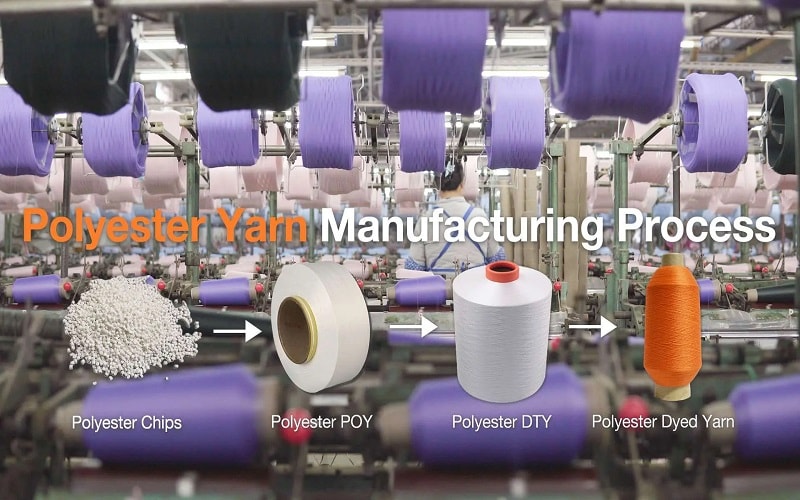
The production process of polyester has evolved to maximize efficiency and consistency. The reaction rate and the method of polymerization are tailored to the intended application.
Polyester production can be carried out in continuous, intermittent, or semi-continuous methods, with the continuous method being the most advantageous.
Large-scale facilities typically utilize the continuous approach to ensure a steady pet melt for downstream extrusion.
Specifically, the continuous direct condensation process of polyester production involves multiple stages, including esterification, pre-condensation, and post-condensation.
In some specialized chemical contexts, ring opening polymerization may be utilized, though polycondensation reactions remain the industry standard.
The resulting condensation product is then processed into polyester chips or directly into fibers.
When selecting a plastic, engineers often compare polyester to nylon or polypropylene.
While nylon may offer higher elasticity, polyester often wins on dimensional stability and chemical resistance.
Specifically, polyester exhibits good resistance to most acids, alkalis, and organic solvents, making it suitable for use in chemical, medical, and food packaging applications.
It shows excellent resistance to most acids, which is vital in industrial filtration.
Safety, Hazards, and Environmental Impact
While polyester is a versatile synthetic polymer, its thermal and chemical nature introduces specific risks that must be managed, particularly in the textile industry.
Thermal Hazards and Flammability
One of the most significant risks involves the polyester melt during a fire.
Polyester fibers are less fire-resistant and can melt when ignited, typically melting at temperatures between 255°C and 265°C.
This behavior creates a unique danger. Specifically, polyester presents a thermal hazard as it melts at lower temperatures, typically between 255°C and 265°C, which can cause serious burn injuries if it sticks to the skin.
In fire situations, polyester tends to melt and can drip or stick to the skin, causing injuries. However, it does not ignite as easily as some natural materials.
In fact, polyester has a high ignition temperature of around 432 °C. Furthermore, polyester tends to melt and stick to surfaces rather than burning immediately.
Health and Static Issues
For the end consumer, polyester is generally safe, though not without minor drawbacks.
Polyester can cause skin irritation in individuals with sensitive skin, but it is not considered a material that produces allergic contact dermatitis.
Additionally, due to its chemical structure, it is prone to static electricity.
Specifically, polyester has a tendency to accumulate static electricity, which can lead to dust attraction and may pose a risk to sensitive electronic components.
The Carbon Footprint
As a derivative of crude oil, the environmental impact of polyester is significant.
The production of polyester is energy-intensive and heavily reliant on fossil fuels, making it one of the more carbon-intensive materials in the textile industry. T
he data is sobering: producing one kilogram of polyester fiber generates approximately 14.2 kilograms of carbon dioxide equivalents.
When considering the full lifecycle, the lifetime carbon emissions of a polyester t-shirt are estimated to be over 20kg CO2e, partly due to the intermediate polyethylene terephthalate in its production.
Versatility in Modern Applications
The basic principles of polyester chemistry allow it to be well suited for an incredible array of tasks. It is frequently the primary component in unsaturated polyesters used in fiberglass and reinforced plastics.
The basic principles of polyester chemistry allow it to be well suited for an incredible array of tasks. It is frequently the primary component in unsaturated polyesters used in fiberglass and reinforced plastics.
To mitigate some of its drawbacks, such as the lack of breathability, polyester is often blended with other fibers like cotton to achieve desirable properties of both materials.
These blends combine the high strength and abrasion resistance of the synthetic polymer with the comfort of natural fibers.
In the world of plastic, pet resin is king for food packaging. Its low permeability and high chemical resistance ensure food safety.
Furthermore, polyester is widely used in clothing, food packaging, industrial films, and automotive components due to its durability and versatility.
Whether it is the thermal expansion properties required for precision engine parts or the abrasion resistance needed for conveyor belts, the melting point of polyester remains the core metric for its success.
Conclusion: Why the Melting Point Matters?
The melting point of polyester is far more than a technical specification; it is the definitive boundary that dictates how the material is synthesized, processed, and safely utilized.
By understanding that polyester fibers typically melt at temperatures between 255°C and 265°C, and acknowledging the molecular structure that provides such heat resistance, industries can continue to innovate.
From the esterification reaction of crude oil derivatives to the final product in a high-tech lab, polyester remains a foundational pillar of modern engineering.