
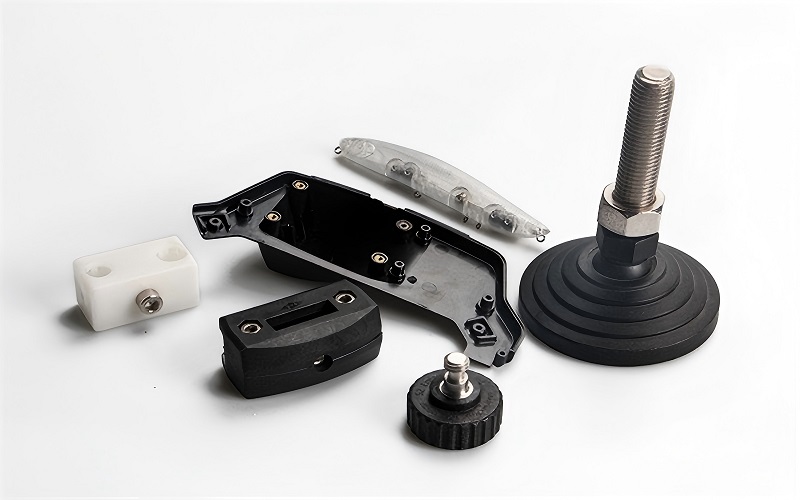
POM injection molding is a specialized manufacturing process for melting and injecting polyoxymethylene into a mold with an injection molding machine.
Since the 1960s, pom plastic has been used where plastic components must behave like precision metal parts.
POM is often called “metal plastic” because it combines stiffness, tensile strength, excellent mechanical properties, and a low coefficient of friction.
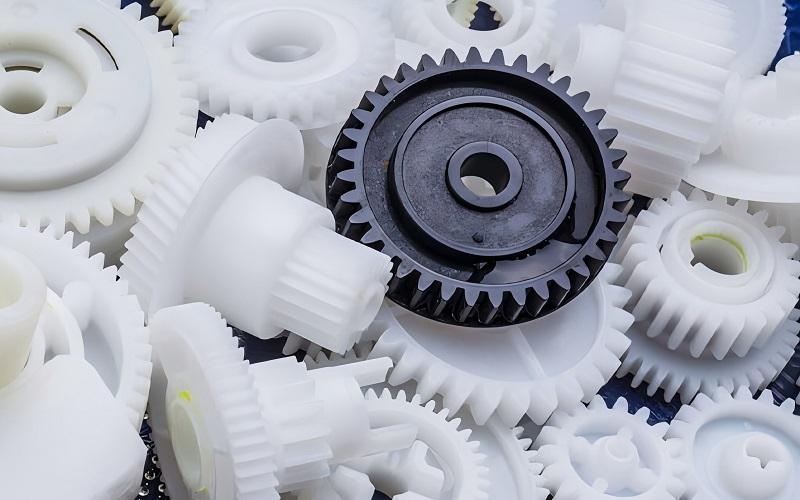
It is a leading choice for precision mechanical parts such as gears, bearings, and sliding mechanisms due to its ability to handle continuous stress.
Typical sectors include the automotive industry, fuel systems, industrial machinery, consumer goods, medical industry, electrical engineering, and fluid handling.
What is Polyoxymethylene (POM)?
POM, also known as acetal plastic or acetal, belongs to the polyoxymethylene family of engineering plastics. Its chemical structure is built around repeating oxymethylene units, which give it high crystallinity and a tightly packed molecular arrangement.
That structure is directly responsible for POM’s exceptional properties — excellent dimensional stability, high mechanical strength, stiffness, and a low friction that makes it naturally self-lubricating.
POM is easily processed through standard plastic injection molding equipment, which makes it attractive for manufacturers across the automotive industry, medical industry, electrical engineering, and consumer goods sectors.
POM is often referred to as “metal plastic” due to its rigidity and high performance, and in many applications it genuinely replaces metal parts at a fraction of the weight and cost.
Two Main Types of POM
Understanding the two main types of POM helps in selecting the right grade for the application.
POM Homopolymer (POM Homopolymer / POM-H)
The pom homopolymer variant exhibits a more regular homopolymer chain structure, leading to higher high crystallinity. This molecular regularity yields a harder material with better mechanical properties, higher tensile strength, and elevated stiffness.
POM Copolymer (Copolymer Versions / POM-C)
Alternatively, copolymer versions (pom c) integrate comonamers that disrupt the crystalline lattice slightly, providing much better thermal stability and preventing rapid polymer degradation.
POM C provides superior chemical resistance against strong alkalis, outstanding creep resistance, and excellent long-term fatigue resistance under cyclic mechanical pressure.
Celanese Corporation is one of the major producers of POM-H under the Delrin brand, while POM-C is widely available from multiple suppliers.
Both main types possess a naturally low coefficient of friction and exceptional self lubricating properties.
Key Properties of POM Material
POM’s exceptional properties come from its high crystallinity and chemical structure, which together produce a material that performs well across a wide range of demanding conditions.
POM has excellent tensile and flexural strength, and its creep resistance allows it to maintain its shape under long-term mechanical stress — a critical property for components that carry continuous loads.
Although POM is a rigid material rather than an elastic material, it absorbs impact and cyclic stress far better than its stiffness might suggest.
POM injection molded parts exhibit excellent fatigue resistance, making them suitable for applications with multiple load/unload cycles such as gears.
Its low coefficient of friction provides excellent lubricity, making it ideal for applications exposed to sliding friction, including rollers, conveyor belts, and sliding mechanisms.
On the chemical side, POM is highly resistant to hydrocarbons, solvents, and neutral chemicals, making it suitable for fluid handling and fuel systems. It also has low moisture absorption, which contributes to its excellent dimensional stability over time.
The one notable limitation is thermal stability at processing extremes — POM has a tight processing window of 180°C to 230°C, and exceeding 240°C can lead to rapid decomposition.
Molten POM also reacts chemically with copper, causing manufacturers to avoid copper components in tooling and machinery to prevent polymer degradation.
POM Injection Molding: Processing Parameters
Getting the processing parameters right is essential with POM. Its narrow thermal window and high shrinkage rates leave little margin for error.
Temperature Control and Mold Temperature
POM requires elevated mold temperatures of 80°C to 100°C for proper crystallization.
Lower mold temperatures produce parts with poor surface finish and inconsistent mechanical properties, while temperatures above the recommended range risk degradation.
Barrel temperature should stay within the 180°C to 230°C window throughout the molding process.
Because molten POM degrades quickly above 240°C, residence time in the barrel must be minimized — especially during startup, shutdown, or any period of machine downtime.
Injection Pressure and Holding Pressure
Injection pressure for POM is typically higher than for many other plastics, reflecting its viscosity and the need to fill complex geometries reliably.
Holding pressure plays a key role in managing shrinkage — maintaining adequate pressure during cooling helps compensate for the material’s natural tendency to contract.
POM is prone to shrinkage rates of 2% to 3.5%, with most shrinkage occurring while the part is still within the mold during the cooling stage.
Insufficient holding pressure leads to sink marks and dimensional inaccuracy, while excessive pressure introduces internal stress.
Shrinkage, Warpage, and Dimensional Stability
Warpage in POM components can result from uneven shrinkage and internal stresses, requiring careful mold design and process optimization to mitigate these issues.
To combat shrinkage and warpage, manufacturers should implement a holistic approach that includes material knowledge, process optimization, and thoughtful mold design.
Uniform wall thickness, balanced runner systems, and consistent cooling across the mold all contribute to better dimensional stability in the finished POM parts.
Beyond temperature and pressure, other factors such as gate location, cooling channel layout, and wall uniformity all play a role in managing POM’s shrinkage behavior.”
Drying POM Before Molding
Although POM has low moisture absorption compared to nylon or other engineering thermoplastics, drying the material before processing is still recommended.
A drying temperature of around 80°C for two to four hours is standard practice.
Even small amounts of residual moisture can cause surface defects and affect mechanical properties in the molded part.
Design Guidelines for POM Injection Molded Parts
Good part design accounts for POM’s specific behavior and avoids the common issues that arise from its high shrinkage rates and stiffness.
Wall thickness should be kept uniform throughout the part. Abrupt changes in wall thickness cause differential cooling, which leads to internal stress, sink marks, and warping.
For POM, consistent wall thickness is especially important given its shrinkage rates. Sharp corners should be avoided — radii of at least 0.5mm help distribute stress and reduce the risk of fatigue cracking in service.
POM’s low coefficient of friction means draft angles can sometimes be minimal, but applying 0.5° to 1° per side is still good practice for reliable ejection and longer mold life.
POM’s excellent dimensional stability and tight tolerances make it well suited for precision components, but achieving those tolerances requires careful attention to mold design, cooling layout, and process control.
Running mold flow analysis before cutting steel helps identify potential problem areas — particularly in parts with complex geometries or varying section thicknesses.
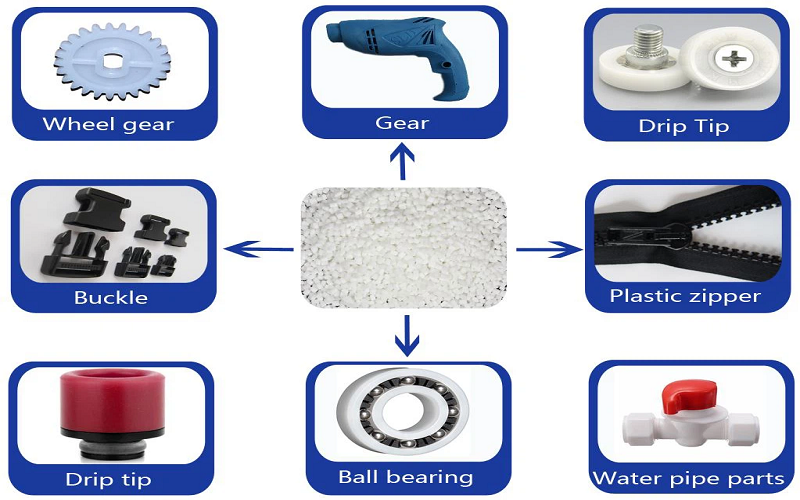
Applications of POM Injection Molding
POM’s diverse applications reflect the breadth of its material capabilities.
In the automotive industry, POM is a leading choice for precision mechanical parts such as gears, bearings, and sliding mechanisms due to its ability to handle continuous stress.
Automotive components commonly made from POM include fuel system modules, seat belt mechanisms, and wiper gears.
POM is widely used for fuel systems including fuel caps, fuel filler necks, and valves, due to its high temperature resistance and durability in harsh conditions.
In the medical industry, POM is favored for its high strength, stiffness, and lubricity, making it suitable for equipment that requires high purity and compliance with FDA standards.
Injection molded POM products can be made from grades rated as food safe, complying with FDA, USDA, and other material standards, making them suitable for food processing equipment.
For fluid handling and plumbing, POM is commonly used for valve housings and water filters due to its low moisture absorption and dimensional stability.
In electrical engineering and electronic devices, POM’s good resistance to chemicals and its dimensional stability under load make it a reliable choice for precision housings and connectors.
Consumer goods applications include conveyor belts, rollers, and fasteners — components that benefit from POM’s self lubricating properties and durability in everyday use.
Common Defects and How to Prevent Them
POM’s tight processing window means defects are usually traceable to temperature, pressure, or design issues.
Sink marks appear when holding pressure is insufficient or wall thickness is uneven — the fix is a combination of adequate pack pressure and consistent wall design.
Warpage comes from differential shrinkage, usually caused by uneven cooling or abrupt geometry changes.
Flash indicates excessive injection pressure or a worn mold, and should be addressed through pressure adjustment and regular tooling maintenance.
Discoloration or a sharp smell during production is a warning sign of thermal degradation — barrel temperatures should be checked immediately and residence time reduced.
Conclusion
POM plastic injection molding rewards manufacturers who respect its processing requirements.
Its exceptional properties — dimensional stability, mechanical strength, creep resistance, fatigue resistance, and self lubricating properties — make it one of the most capable engineering thermoplastics available.
Whether you’re producing precision automotive parts, medical components, or fluid handling systems, POM delivers consistent, high-quality results when the process is dialed in correctly.
Choose the right grade between POM-H and POM-C, control temperature carefully, design for uniform wall thickness, and POM will do the rest.