
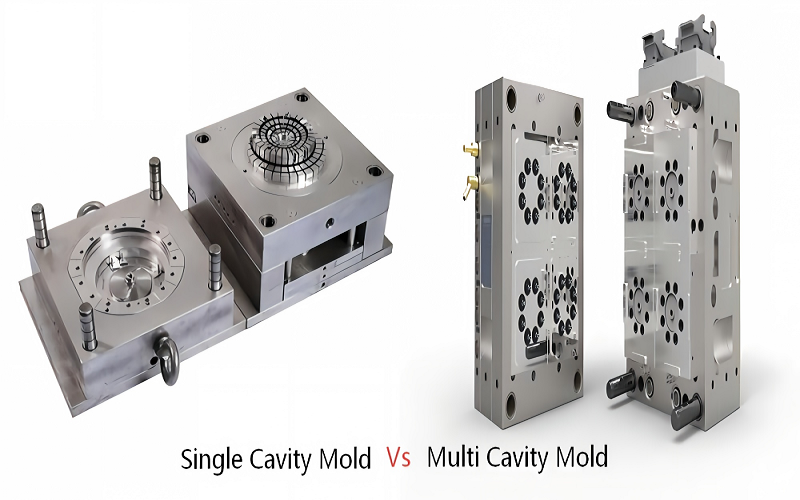
In the plastic injection molding manufacturing process, the choice of mold plays a crucial role in production efficiency, cost control, and product quality.
The number of mold cavities directly determines how many products can be produced in a single injection cycle, thereby affecting production efficiency, mold cost, and the cost per piece.
Single cavity molds and multi cavity molds are two common types of injection molds. They differ significantly in structure, cost, production efficiency, and precision control, which directly impacts the initial investment, mass production efficiency, and the final product cost.
This article will systematically compare the key differences between single cavity vs multi cavity molds to help manufacturers and engineers select the appropriate mold type based on production needs, product complexity, and budget, thereby achieving efficient and cost-effective production goals.
What Is A Single Cavity Mold?
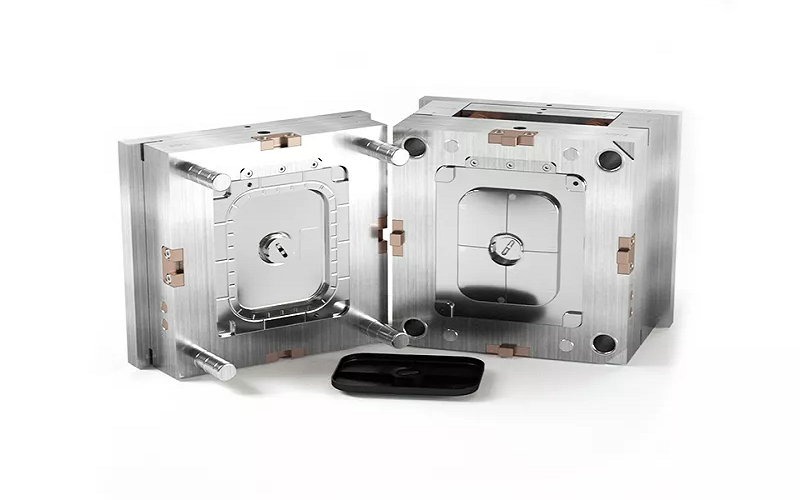
A single cavity mold is a type of injection mold that contains only one cavity (or mold space), into which molten plastic is injected during each molding cycle to form a single part. This means that only one plastic part can be produced per cycle.
Single cavity injection molds are typically used for low-volume production, prototyping, or situations where the product design is complex and requires high attention to detail and quality.
They have lower initial mold costs and shorter lead times , making them suitable for projects where design changes are expected or production processes require flexibility.
However, because only one part is produced per cycle, the production time per part is longer compared to multi cavity injection molds.
This can lead to higher costs per part in large-scale production. Nevertheless, single cavity tool remain a suitable choice for applications that prioritize quality, complex part geometry, or low-volume production.
What Is A Multi-Cavity Mold?
Multi-cavity molds are injection molds that contain multiple cavities within a single mold structure. allowing for the production of multiple identical parts simultaneously in a single cycle, significantly improving production efficiency and output compared to single-cavity molds.
Multi-cavity injection molds are typically used for high-volume production where producing large quantities of identical parts is essential. For example, a 10-cavity mold can complete an order of 1,000 parts in 100 cycles, greatly reducing cycle time and increasing output.
Additionally, there is a special types of multi cavity tools called a family molds, which can simultaneously mold multiple parts that are structurally similar but not exactly the same parts within the same mold set, further enhancing production flexibility.
Although multi-cavity molds require higher upfront investment and mold costs, they minimize machine downtime by reducing cycle counts. This makes multi-cavity molds an economical and efficient choice for large-scale manufacturing to produce identical parts.
Key Differences Between Single-Cavity And Multi-Cavity Molds
Single-cavity molds and multi-cavity molds are two common types of injection molds, and they have significant differences in structure, production efficiency, cost, and quality control.
The Number Of Injection Mold Cavity
A single-cavity mold contains only one cavity and produces one part per injection cycle. A multi-cavity mold, on the other hand, features two or more cavities (commonly 2, 4, 8, 16, or higher), allowing multiple components to be produced in a single cycle.
Although multi-cavity molds can accommodate a higher number of cavities per cycle, their design and manufacturing processes are more time-consuming and require longer lead times.
This difference in cavity number directly impacts production efficiency, cost structure, quality control, and overall results of the entire process.
Production Volume
Single-cavity molds are ideal for low production volumes or projects requiring high precision and complex part geometry. They allow for more flexibility in design changes and have shorter lead times due to simpler mold construction.
In contrast, multi cavity injection molds are designed for high-volume production, enabling efficient production of large quantities of injection molded parts in one cycle.
For example, a mold with eight cavities can produce eight parts simultaneously, significantly reducing the overall production time compared to single-cavity molds.
Cost Considerations
While single-cavity molds have a lower initial mold material and manufacturing cost, their cost per part is higher when scaled up due to longer cycle times and fewer parts produced per cycle.
Multi-cavity molds require a higher upfront investment because of the complexity and mold material used but offer lower cost per part in large production volumes due to efficient simultaneous production and optimized runner layouts. Initial tooling costs for family molds are higher than multi-cavity molds.
Design Complexity
Single-cavity molds are simpler in design and easier to modify, making them suitable for prototyping and products with design complexity.
Gate design, cooling channels, runner system, and parting line placement are critical key considerations to ensure uniformity and maintain mold life. Multi cavity injection molds involve a more intricate runner layout and require precise cavity balancing to ensure even material flow and consistent part quality.
The entire mold must be meticulously engineered using CNC machining and mold flow analysis to optimize the runner system and minimize defects.Family molds demand even more complex tooling due to the presence of multiple distinct designs.
Maintenance Requirements
Single-cavity molds are easier to maintain due to their relatively simple structure, with fewer cavities, runners, cooling channels, and ejection systems. When issues arise (such as wear, clogging, uneven cooling, or ejection abnormalities), troubleshooting and repairs are more straightforward and quicker.
Multi-cavity molds require regular cleaning, inspection, and preventive maintenance to avoid wear that could affect all cavities simultaneously. Family injection molds, a variant of multi-cavity molds that produce multiple parts in a single production cycle with varying part designs, require more frequent mold adjustments.
Applicable Batch
Single-cavity molds are preferred for consumer electronics and other industries where complex assemblies and high-quality parts are needed in lower volumes. Multi cavity injection molds excel in producing multiple identical cavities efficiently for mass production, ensuring cost effectiveness and efficient production.
Choosing the right mold depends on production volume, part complexity, quality requirements, and budget. A mechanical engineer or mold designer must evaluate these factors to select the right mold that balances cost, efficiency, and part quality for the entire mold and production process.
| Comparison Aspect | Single-Cavity Mold | Multi-Cavity Mold |
|---|---|---|
| Number of Cavities | 1 | 2, 4, 8, 16 or more |
| Production Efficiency | Lower (one part per cycle) | Higher (multiple parts per cycle) |
| Mold Cost | Lower | Higher |
| Lead Time | Shorter | Longer |
| Unit Cost | Higher (especially in high-volume runs) | Significantly lower in high-volume production |
| Dimensional Consistency | Easier to control | Requires precise runner balance and process control |
| Design Complexity | Simpler structure, easier to debug | More complex, higher demands on gating system |
| Maintenance Difficulty | Lower | Higher |
| Best Suited For | Low to medium volume, prototyping, complex parts | High-volume production, standardized parts |
Conclusion
A single-cavity mold is preferable when the product is still being developed and design changes are likely. This is because single-cavity molds offer greater flexibility and shorter lead times, allowing for easier modifications during the prototyping and early production stages. They are ideal for low-volume production runs where precision and quality are prioritized over quantity.
In contrast, multi cavity injection molds are better suited for high-volume manufacturing of standardized plastic parts, where efficiency and reduced cost per unit are critical.
Ultimately, choosing between single-cavity and multi-cavity molds depends on factors such as production volume, product complexity, budget, and timeline.
Careful evaluation of these aspects will help manufacturers select the most cost-effective and efficient mold type to meet their specific production needs and ensure optimal product quality.