
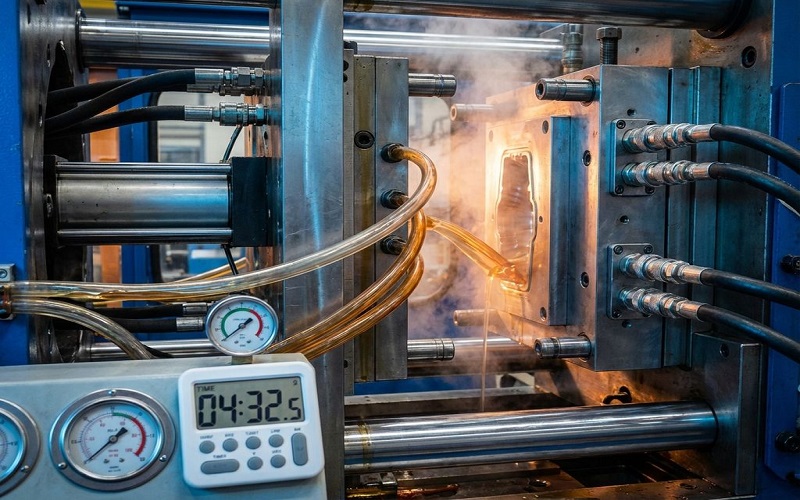
Injection molding cooling time is a critical phase in the plastic injection molding process, directly affecting product quality, production efficiency, and cost.
The length of the cooling time not only determines the injection molding cycle time but also relates to the dimensional stability, surface finish, and internal stress distribution of the molded parts.
This article will delve into the main factors influencing injection molding cooling time, helping mold designers and production managers comprehensively understand how to optimize the cooling process to enhance the overall performance and production efficiency of injection molded parts.
What Is Cooling Time In Injection Molding?
Cooling time in injection molding refers to the period during the molding cycle when the molten plastic inside the mold cavity solidifies and cools down to a temperature that allows the part to be ejected without deformation or damage.
This phase is crucial because it directly impacts the quality, dimensional accuracy, and mechanical properties of the final plastic part.
During the cooling phase, heat is transferred from the molten plastic to the mold through the mold surface and cooling channels embedded in the mold design.
The efficiency of this heat transfer depends on several factors, including the mold temperature, melt temperature, thermal conductivity of the mold material, and the cooling channel layout.
Why Cooling Time Dominates Injection Molding Cycle Time?
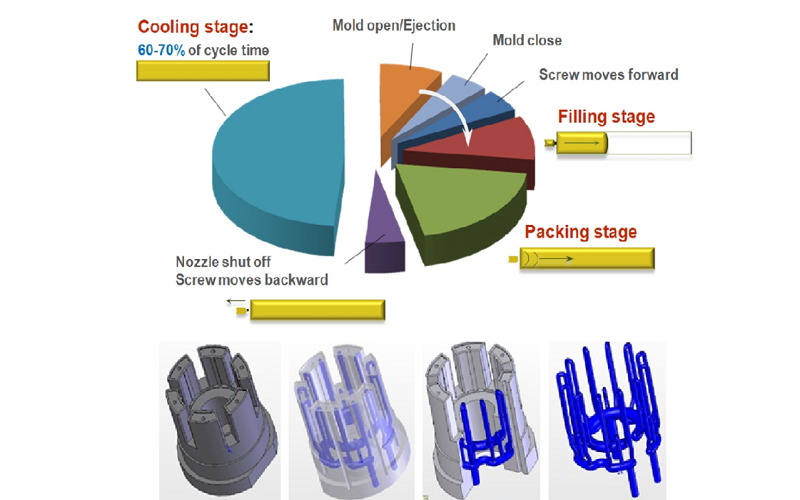
Cooling time is the major factor that dominates the overall injection molding cycle time. This is because the molten plastic must be sufficiently cooled and solidified before the molded product can be ejected from the mold properly without deformation or damage.
Typically, cooling time accounts for the largest portion of the injection molding cycle time, often representing up to 85% of the total cycle.
The length of the cooling phase is primarily influenced by the wall thickness of the plastic part, with thicker sections requiring more time to fully solidify. Cooling time can vary widely, ranging from just a few seconds to several minutes, depending on the part’s design and material properties.
Critical Factors Affecting Injection Molding Cooling Time
Injection molding cooling time is influenced by many factors that interact to determine how quickly the molten plastic solidifies and reaches a stable state for ejection. Understanding these factors is crucial for optimizing cycle times and ensuring product quality.
Part Design and Wall Thickness
Since cooling time is proportional to the square of the wall thickness, thicker parts require significantly longer cooling times. Designers should consider the product dimensions carefully to estimate the necessary cooling duration.
Wall thickness of the part is one of the most important factors affecting cooling time. Since cooling time is proportional to the square of the wall thickness, thicker sections require longer cooling times.
The surface layer of the plastic part cools faster than the interior (core). If cooling is uneven across the thickness, internal stresses may develop, leading to warpage. Maintaining uniform wall thickness and avoiding abrupt changes in thickness help minimize uneven cooling and internal stress.
Material Properties
Materials exhibit different thermal properties affecting cooling times and processes.Materials with higher thermal diffusivity transfer heat more efficiently, thereby shortening cooling time.
The melting point and crystallization temperature also play key roles; materials with higher heat deflection temperature generally require shorter cooling times.
Different materials and part designs exhibit varying shrinkage rates, which affect the time needed for the part to stabilize dimensionally before ejection.
Mold Design
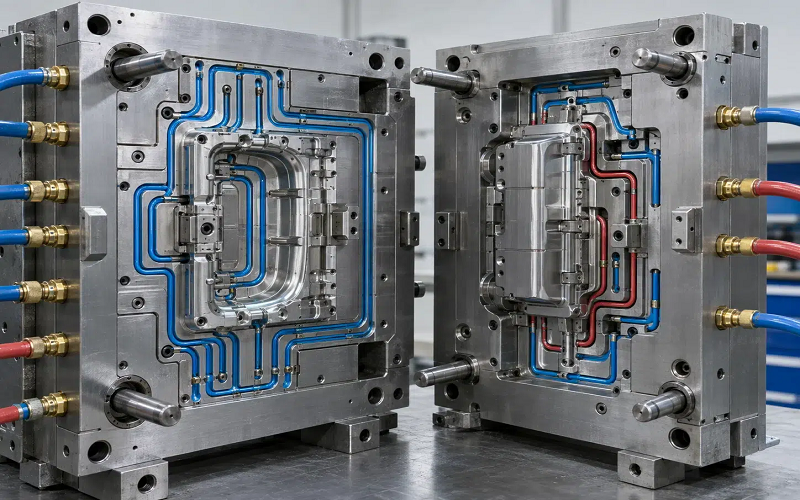
The design and layout of cooling channels inside the mold directly affect heat dissipation efficiency. Well-designed cooling channels with optimized flow rates ensure effective temperature control throughout the mold, maintaining uniform cooling temperatures.
Mold design should avoid local overheating (hot spots) and ensure uniform surface temperature across the cavity, reducing the risk of warpage and shrinkage.
Process Parameter Settings
Excessively high melt temperature or mold temperature will extend cooling time. While lower processing temperatures helps reduce cooling time, in practice, it is necessary to balance material flowability and part quality requirements to find the optimal compromise.
Mold temperature refers to the surface temperature of the mold cavity and core during the molding process. Correct mold temperature is crucial as it not only affects the cooling rate and crystallization temperature but also directly relates to the mechanical properties of the plastic part.
Low mold temperature may cause rough surfaces and incomplete crystallization, while high mold temperature, although beneficial for crystallization, can increase cooling time.
Process parameters such as injection time, holding time, and flow rate influence the temperature distribution and cooling needs of the part; thus, reasonable adjustment of these parameters is also important for optimizing the cooling process.
By carefully considering these many factors, manufacturers can optimize injection molding cooling time to improve production efficiency, reduce energy required, and produce high-quality plastic components with consistent performance.
How To Optimize And Reduce Cooling Time?
Optimizing and reducing injection molding cooling time is crucial for improving production efficiency and lowering manufacturing costs. Here are common method:
1. Rational Design Of Part Thickness and Structure
Controlling the wall thickness of the part is one of the most effective ways to reduce cooling time. During design, it is important to maintain uniform wall thickness to avoid uneven cooling and internal stresses caused by varying thickness. Additionally, using ribs instead of increasing wall thickness can reduce cooling time while ensuring part strength.
2. Optimize Mold Cooling System Design
The design of cooling channels within the mold plays a crucial role in heat transfer efficiency. Innovative designs such as conformal cooling channels can closely follow the geometry of the part, enhancing heat transfer and shortening cooling time. Furthermore, turbulent flow of the cooling medium within the channels can further improve heat exchange efficiency.
3. Control Mold Temperature and Injection Parameters
Maintaining a stable and appropriate recommended mold temperature not only helps improve the dimensional stability of parts but also avoids post-crystallization and deformation.
Reasonable adjustment of injection molding machine parameters, such as injection speed, holding time, and melt temperature, can optimize heat distribution and cooling efficiency.
4. Refer to Material Data Sheets For Suitable Material Selection
Different materials have varying thermal diffusivity and thermal conductivity, which directly affect cooling time. Referring to the thermal performance parameters in material data sheets and selecting materials with better thermal conductivity or additives can help shorten cooling time.
6. Maintenance and Equipment Upgrades
Maintaining injection molding machines and molds in good condition prevents cooling channel blockages and equipment performance degradation.
Injection molding machines with precise process control capabilities and efficient heating and cooling systems help ensure stable production performance.
Maintaining stable mold temperature through precise temperature control systems helps avoid uneven cooling, preventing warpage and dimensional deviations in parts.
By applying these methods, manufacturers can effectively reduce injection molding cooling time while ensuring the final product quality and dimensional accuracy, thereby improving production efficiency and reducing energy consumption and costs.
Calculating Cooling Time During The Injection Molding Process
During the mold design phase, engineers typically use theoretical formulas or CAE mold flow analysis software for prediction. The following formula is mainly based on the one-dimensional heat conduction equation:
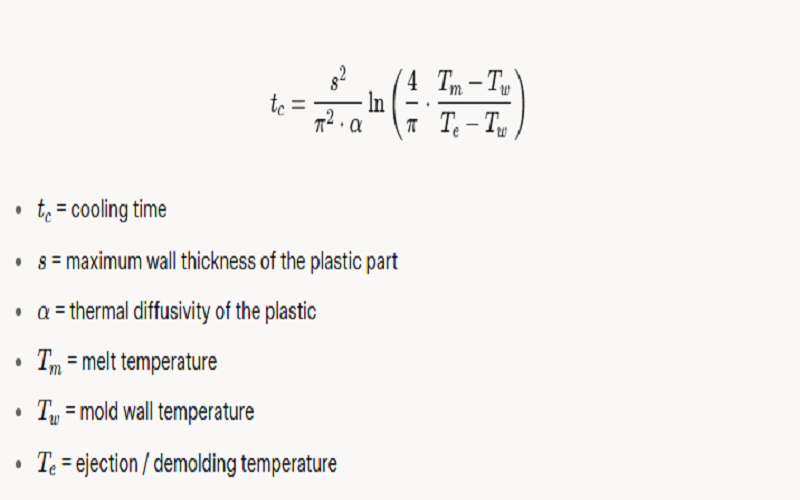
As a quick estimation “industry rule of thumb,” the cooling time for ordinary plastic parts with a 2mm wall thickness is usually around 10 seconds, about 21 seconds for 3mm, and it jumps to approximately 36 seconds for 4mm.
Conclusion
Injection molding cooling time is a vital factor that significantly influences the overall cycle time, product quality, and manufacturing efficiency.
By understanding the critical roles of part design, material properties, mold design, and process parameters, manufacturers can strategically optimize cooling to reduce cycle times while maintaining high-quality standards.
Proper control of mold temperature and innovative cooling system designs such as conformal cooling channels are key to achieving uniform cooling, minimizing defects, and enhancing dimensional stability.
Ultimately, balancing these factors enables cost-effective production of reliable and precise injection molded parts, meeting both performance and economic goals in modern manufacturing.