
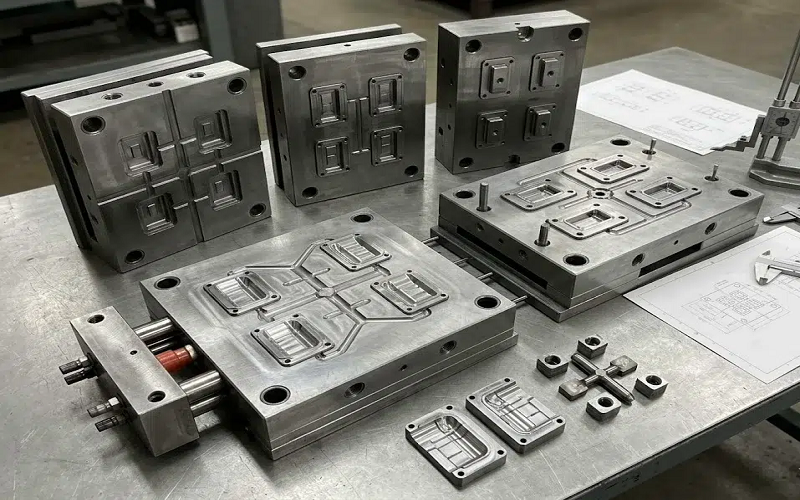
Injection molding is a key manufacturing process in modern manufacturing, widely used for the mass production of plastic parts and capable of rapidly producing thousands of components.
In plastic injection molding ,mold is core tooling choices that shape part quality, production speed, and overall project cost.
The choice of mold type is crucial because it determines how molten material flows into the cavities, how the parts are cooled and ejected, and how much waste is generated during the process.
Mold types are commonly classified by plate design, runner system, and cavity layout, and choosing the right injection mold can optimize the production process, reduce material waste, and minimize injection molding defects.
This article outlines the common types of injection molds, their structural characteristics, and their application scenarios so injection mold manufacturers and plastic manufacturing professionals can make better mold design and mold selection decisions for plastic manufacturing projects.
What Is Injection Mold?
Injection molds are tools installed on an injection molding machine used to form plastic parts. They consist of two halves surrounding the mold cavity, separated by a parting line.
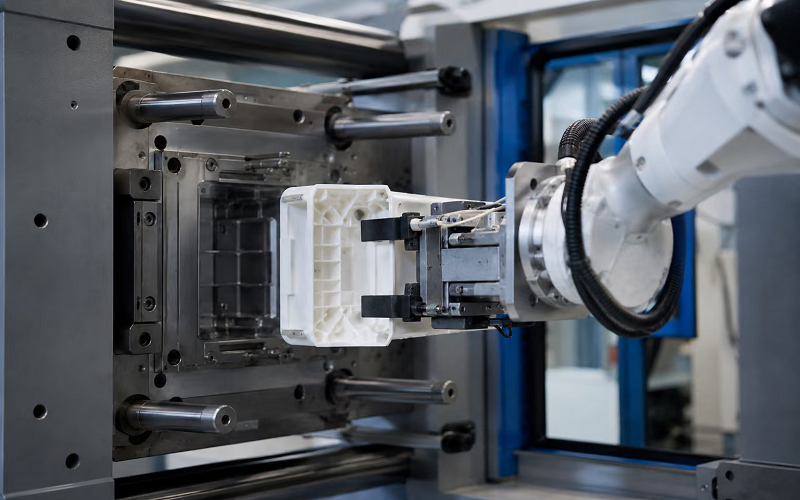
During the injection molding cycle, molten plastic resin is injected into the mold cavity under high pressure, followed by filling, packing, cooling, and ejection steps. Ejector pins then push the part out. Thermoplastics are commonly used because they are easier to recycle than many other plastics.
Cooling systems can shorten the cycle time and support precise control of injection molded parts, achieving extremely high dimensional accuracy and enabling the manufacture of complex geometries.
Common injection molds are typically made from tool steel or aluminum, and mold selection also depends on the expected lifespan specified by SPI standards. Generally, injection molds can last for over one million cycles.
What Types Of Injection Mold Used In Injection Molding Process ?
Different injection molding processes are suitable for different part designs, materials, and production goals, so the applicable mold types vary accordingly. Injection molds are classified based on their plate structure, runner system, and cavity layout.
Each mold type has its unique structural design and working principle, capable of meeting diverse production needs and product requirements.
1.Plate Structure Types
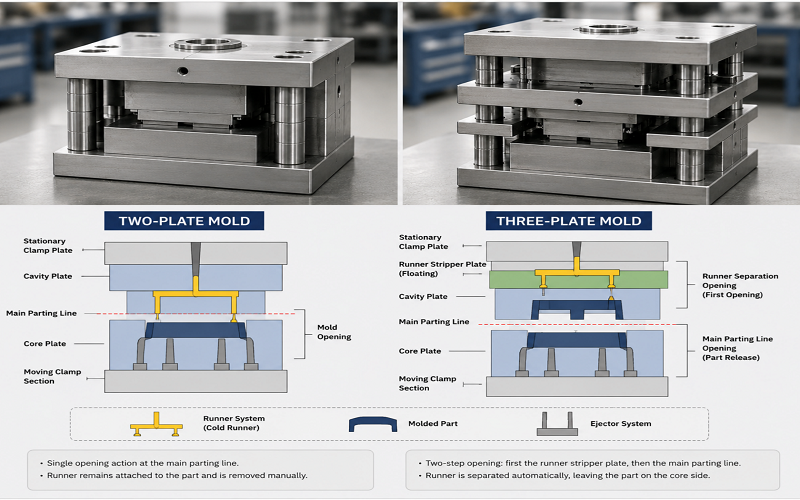
The mold plate classification primarily differentiates molds by the number of plates they consist of, which directly affects the mold’s complexity and the injection process. The two main types are two plate injection molds and three plate injection molds.
Two Plate Injection Mold
This is the most traditional and commonly used mold type. It consists of two mold halves: the cavity side and the core side. The parting line is where these two halves separate.
The feeding system is integrated into the mold, and the runner and gate are ejected along with the part. This type is suitable for simple parts and is one of the common single cavity molds for prototypes or low-volume runs due to its lower tooling cost and simpler design.
Three Plate Injection Mold
This mold includes an additional plate between the cavity and core plates, allowing the runner system to be separated from the molded part. This design enables the runner to be ejected separately, which is advantageous for parts requiring a clean gate or complex geometries.
Three plate molds are more complex and costly but offer better control over the injection process and are often used to produce plastic parts in high volume production.
2. Runner System Types
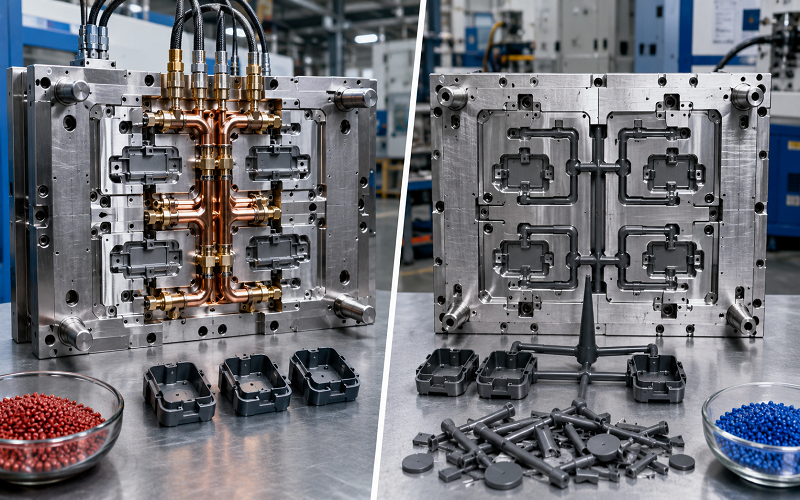
Injection molds can also be classified by their runner system, which controls how molten plastic flows into the mold cavities. The two primary types are cold runner molds and hot runner molds.
Cold Runner Molds
In these molds, the runner channels are cooled along with the mold, causing the molten plastic in the runners to solidify along with the part.
This results in excess material, known as sprue and runner waste, which must be trimmed and recycled. Cold runner molds are simpler and less expensive but generate more waste and may increase cycle time.
Hot Runner Molds
These molds incorporate a hot runner system that keeps the runner channels heated, allowing molten plastic to remain fluid and flow continuously into the cavities. This eliminates runner waste, reduces cycle times, and improves material efficiency.
Hot runner molds are more expensive and require more maintenance but are preferred for high volume production and complex parts.
Insulated Runner Mold / Insulated Runner Tools
The main advantage of this mold design lies in its combination of the benefits of both cold runner and hot runner molds. It can reduce material waste while maintaining relatively low maintenance costs.
Through the naturally formed insulating layer, the temperature of the plastic in the center of the runner is effectively maintained, avoiding the need to heat the entire runner system, thereby saving energy consumption.
This mold is closer to traditional cold runner molds but creates a layer of molten plastic surrounding the runner by using tubular heaters or other heating methods.
3. Cavity Number
The mold cavity classification refers to the number and arrangement of cavities within a mold, impacting production volume and efficiency.
Single Cavity Mold
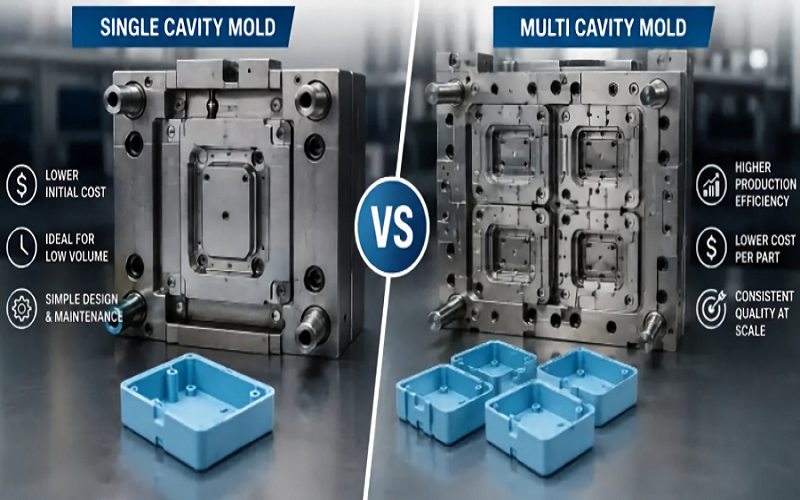
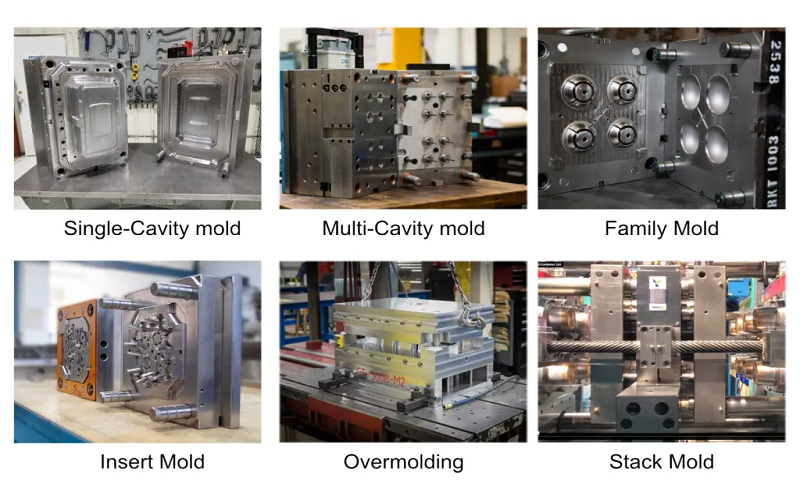
These molds have one cavity and produce one part per injection cycle. single cavity molds are simpler and faster to build, making them well suited to prototyping, low-volume production, or large parts where multi-cavity layouts are impractical.
Multi Cavity Mold
A multi cavity mold contains multiple cavities, capable of producing multiple parts in a single injection cycle. Some extremely high-volume molds, such as those used for manufacturing bottle caps, can even have more than 128 cavities.
Multi cavity injection molds increase production rates and reduce per-part costs. In high-volume production, this setup is especially cost-effective because it makes identical parts simultaneously. However, they require precise design to ensure uniform resin flow and balanced injection pressure.
Family Mold
Also known as family injection molds, these molds produce multiple different parts in a single injection cycle. They are efficient for manufacturing kits or assemblies with multiple components but require careful balancing to maintain consistent quality across all parts.
4. Special Functions And Structural Classification
- Stack Molds: These molds consist of multiple mold plates stacked vertically, allowing for multiple cavities to be molded in a smaller footprint. Stack molds increase productivity by producing more parts per cycle without requiring a larger machine.
- Unscrewing Molds: The mold uses a rotating internal component that automatically loosens the threaded plastic cap or threaded hole before the part ejects. For complex parts, the demolding process is automated.
- Rotary / Index Mold : These molds incorporate a rotating or indexing mechanism that moves the molded part between different stations within the mold for multi-step injection molding processes. This allows for complex parts or multi-material molding within a single cycle.
- Slide & Lifter Mold : Equipped with sliding components or lifters that move perpendicular to the mold opening direction, these molds enable the formation of undercuts, side holes, or complex geometries that cannot be formed by simple two-plate molds.
- Insert Mold: Insert molds use positioning devices such as magnets, spring pins, and locating pillars to accurately place pre-made plastic or metal inserts into the mold cavity. During the insert injection molding process, plastic is injected into the mold, firmly bonding the insert with the plastic to form a single unit, enhancing part strength and conductivity while reducing assembly steps.
By understanding these classifications based on mold plate, runner system, and cavity layout, injection molding manufacturers and mold makers can optimize production efficiency for a wide range of plastic materials and product designs.
Injection Mold Manufacturing Process
Injection mold manufacturing is a precise and complex process that involves multiple stages to ensure the production of high-quality molds capable of producing consistent plastic parts. The process typically includes design, material selection, machining, assembly, and quality control.
1. Mold Design
The manufacturing process begins with detailed mold design based on the part’s geometry, desired shape, and production requirements.
Engineers use CAD software and mold flow analysis tools to optimize material flow, injection speed, cooling channels, and gate locations.
This step ensures the mold will produce parts with minimal defects and high dimensional accuracy.
2. Material Selection
Mold materials are chosen based on expected production volume, part complexity, and required durability.
Tool steels are commonly used for high-volume production molds due to their high hardness and wear resistance, capable of withstanding over 1,000,000 cycles. However, the cost of such molds can reach hundreds of thousands of dollars.
Aluminum molds are preferred for prototyping and low-volume runs because of their cost-effectiveness and faster machining times.
3. CNC Machining
CNC machining is a critical step in mold manufacturing, enabling precise cutting and shaping of mold components.
High-precision CNC machines create the mold cavities and cores according to the design specifications. Electrical Discharge Machining (EDM) may also be used for intricate details and hard-to-machine areas.
4. Heat Treatment
For steel molds, heat treatment processes such as hardening and tempering are applied to improve the mold’s mechanical properties, enhancing wear resistance and extending its lifespan.
5. Assembly and Fitting
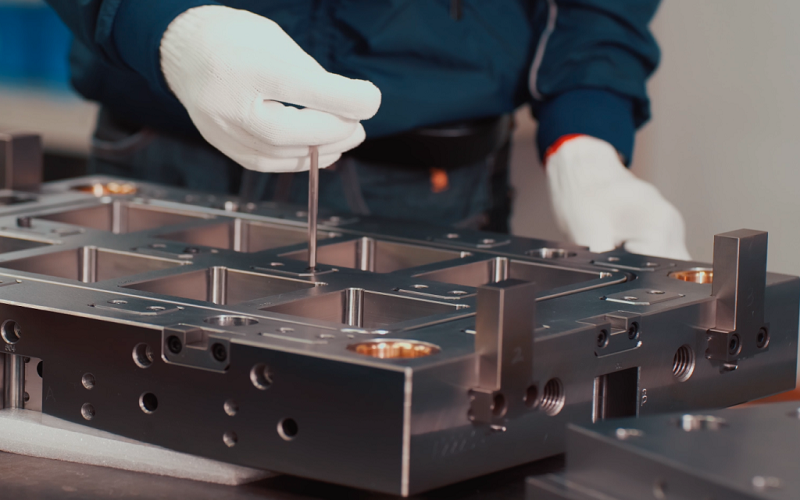
Once machining and heat treatment are complete, the mold components are carefully assembled. Quality control checks ensure proper alignment and fit of all parts, including the runner system and ejector pins. This step is crucial to avoid defects caused by misalignment or improper sealing. At this stage, the mold maker typically handles final assembly, fitting, and checks before approving the tooling for production use.
6. Quality Control
Comprehensive quality control measures, including dimensional inspections and trial runs, verify that the mold produces parts meeting the desired specifications. Adjustments are made as necessary to optimize mold performance.
7. Maintenance
Regular maintenance of the mold, including cleaning, lubrication, and inspection, is essential to maintain consistent quality and prolong mold life during production.
By following these manufacturing steps with attention to detail and quality control, injection molds can reliably produce high-quality parts with complex geometries and precise tolerances, meeting the demands of modern plastic manufacturing.
How To Choose The Right Mold Type, Material & Process?
Choosing the right type of injection mold requires a comprehensive consideration of the part’s design complexity, the characteristics of the plastic material used, the expected production volume, and the budget constraints, ensuring a smooth injection molding process and high-quality final products.
Design Complexity
When selecting a mold type, the first step is to evaluate the structural complexity of the part. Large parts may require specialized equipment and additional considerations for proper filling, cooling, and mold release.
Complex parts may require three-plate molds or molds with special features such as slides and side cores to ensure molding quality and smooth demolding. Simple parts can use two-plate molds to reduce mold manufacturing costs.
Plastic Material Properties
The physical and chemical properties of the plastic material directly affect mold design. For example, thermoplastic plastics are generally suitable for conventional cold runner or hot runner systems, while thermosetting plastics may require specific mold designs and process parameters.
Material flowability, melting temperature, and cooling speed will influence the design of the mold cooling system and injection parameter adjustments.
Expected Production Volume
The anticipated production volume determines the mold lifespan and investment scale. High-volume projects are suitable for durable steel molds and hot runner systems to reduce waste and improve production efficiency.
Low-volume or prototype manufacturing can consider aluminum molds or cold runner systems for quick response to design changes and lower initial investment.
Budget Constraints
Budget is a key limiting factor in mold type selection. A balance must be found between mold manufacturing cost, production efficiency, and material utilization.
Although hot runner molds have higher upfront costs, they significantly reduce waste and post-processing expenses, making them suitable for long-term mass production.
Wall Thickness
Additionally, the part’s design should maintain a uniform wall thickness to prevent molding defects such as weld lines and sink marks, thereby enhancing structural integrity and surface finish.
Typical wall thickness for injection molded parts ranges from 1 to 3.5 millimeters, while thin-wall injection molding produces parts with wall thicknesses less than 1 millimeter.
Functional Requirements
For multiple parts or complex assemblies, family molds or multi-cavity molds can be chosen. Micro injection molding technology is suitable for manufacturing extremely small and high-precision parts such as electrical components.
Other molding techniques such as compression molding can also be combined with injection molding processes depending on product requirements, while micro injection molding is suitable for manufacturing extremely small and high-precision parts.
In summary, selecting the appropriate types of injection mold requires not only technical considerations but also economic efficiency and practical production factors to ensure the optimal balance between product quality and manufacturing cost.
| Project Situation | Recommended Mold Type | Reason |
|---|---|---|
| Simple part, low to medium volume | Two-plate + Cold runner | Lowest cost and simplest structure |
| Need point gate or automatic degating | Three-plate mold | Better gate location and cleaner parts |
| Medium volume, want to reduce waste | Insulated runner | Lower waste than cold runner, cheaper than hot runner |
| High volume, minimal waste required | Hot runner | Highest efficiency and lowest material waste |
| Very high volume, simple parts | Stack mold | Doubles output on the same machine |
| Parts with side holes or undercuts | Slide / Lifter mold | Enables complex features |
| Parts with internal or external threads | Unscrewing mold | Protects thread quality |
| Metal + plastic integrated parts | Insert mold | Reduces assembly steps |
| Multi-color or soft-hard combination | Rotary / Index mold | One-step multi-material molding |
Conclusion
Understanding the different types of injection mold, selecting the right mold material, and following a proper manufacturing process are the three critical factors that determine the success of any plastic injection molding project.
Choosing the wrong mold type or material can lead to higher costs, longer lead times, quality problems, or even project failure. On the other hand, making informed decisions in these areas helps achieve better part quality, higher production efficiency, and lower overall costs.
Working with an experienced and professional mold supplier adds significant value. A reliable partner can evaluate your part design, production volume, material requirements, and budget together, then recommend the most suitable mold solution instead of simply offering the most expensive option.
Their expertise in mold design, material selection, and precision manufacturing reduces risks and helps avoid costly mistakes.
If you are planning a new injection molding project or looking to optimize an existing one, we are ready to help. Contact us today to discuss your requirements and receive a customized mold solution with a competitive quotation.