
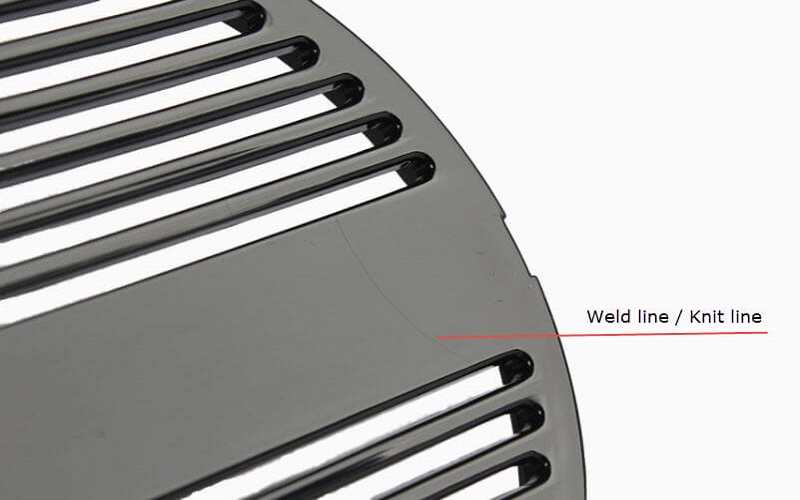
In the injection molding process, knit lines are a common and significant defect that affects product quality.
Knit lines typically appear where the fronts of molten plastic flow meet, resulting in visible linear marks on the surface of the molded parts. These not only impact the appearance but can also reduce the structural integrity and tensile strength of the product.
With the growing demand for high-quality plastic parts in manufacturing, understanding the causes of knit line formation and their solutions is crucial for optimizing the injection molding process, improving production efficiency, and reducing production costs.
This article will explore in depth the causes of knit lines, key parameters in the injection molding process, and how to effectively avoid the formation of knit lines through reasonable mold design and process adjustments.
It aims to help engineers and manufacturers effectively control this defect and ensure that finished parts meet the expected quality standards.
What Is A Knit Line In Injection Molding?
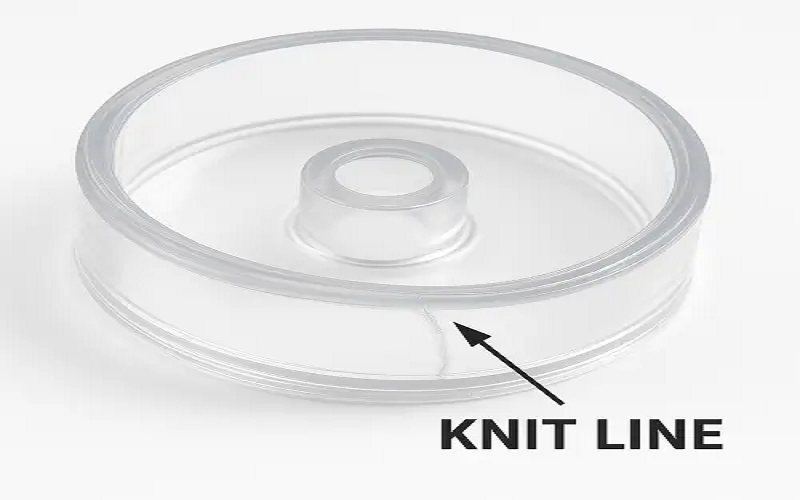
A knit line, also known as a weld line or meld line, is a visible molding defect that occurs in plastic injection molding when two or more flow fronts of molten plastic meet but do not fully fuse together.
This results in a line or seam on the surface of the molded part, which can be seen as a discoloration, a slight depression, or a weak point in the structure.
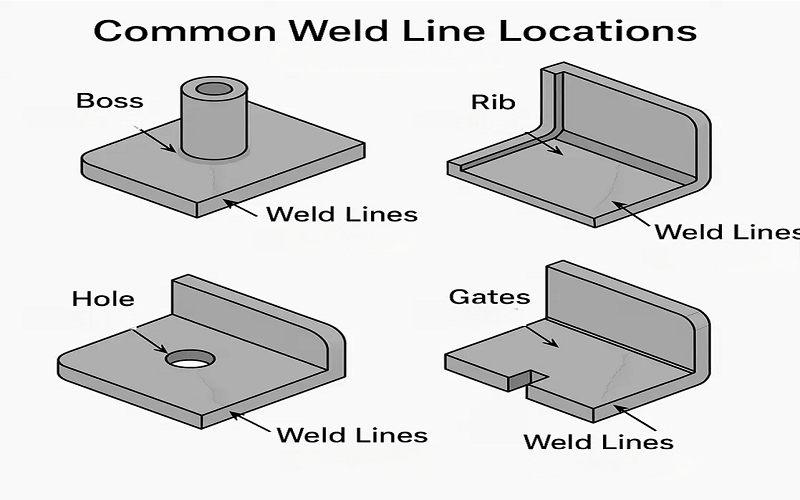
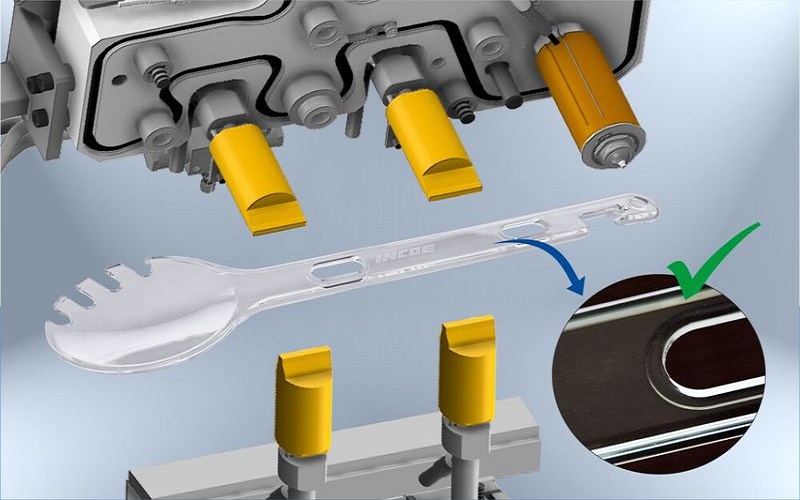
Knit lines often form around holes, ribs, or other complex geometries where the molten plastic flows from different directions and converges.
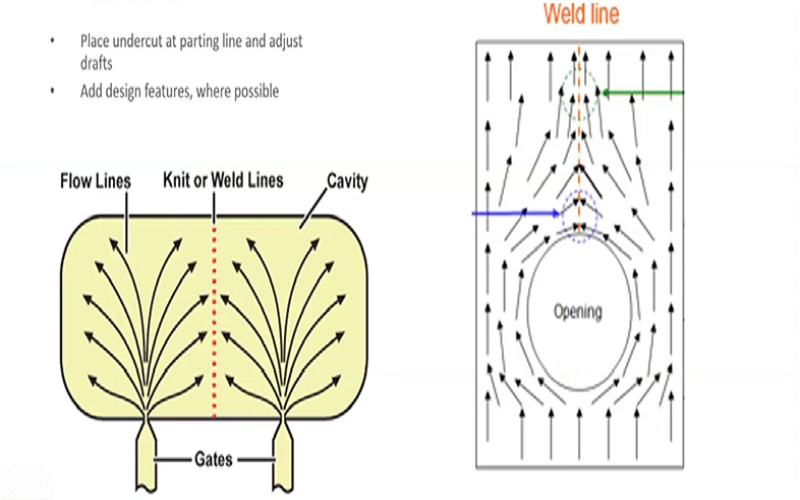
When the molten plastic cools too quickly or the flow fronts solidify before fully merging, the molecular bonding between the fronts is incomplete, leading to the formation of knit lines.
This often happens when the plastic in some areas becomes gummy due to premature cooling, preventing proper fusion between the flow fronts.
It is important to note that knit lines differ from meld lines. When two flow fronts collide head-on at a relatively small angle (typically less than 135°) and cool rapidly, weaker knit lines are more likely to form.
In contrast, when the converging angle is larger and the melt remains at a higher temperature, better-fused meld lines may result.
Causes Of Knit Lines In Injection Molding
Understanding the causes of knit lines is essential for minimizing their occurrence and producing high-quality injection molded parts. Several key factors contribute to the formation of knit lines during the manufacturing process.
Mold Design And Gate Location
Mold design plays a crucial role in the development of knit lines. The location and number of gates affect how the molten plastic flows into the mold cavity. Poor gate placement can cause multiple flow fronts to meet prematurely or at unfavorable angles, increasing the likelihood of knit line formation.
Adjusting gate location during the mold design phase can help avoid knit lines in critical areas, ensuring a more uniform fill and better part integrity.
Injection Speed and Pressure
Injection speed is a vital parameter in controlling knit lines. If the injection speed is too slow, the molten plastic cools down too much before the flow fronts meet, preventing proper fusion. Increasing the injection speed helps maintain the melt temperature and flow, reducing the chance of knit lines.
Similarly, injection pressure must be sufficient to push the molten material into all areas of the mold, ensuring complete filling and minimizing defects.
Temperature Control
Both the melt temperature and mold temperature influence knit line formation. Higher melt temperatures improve molecular diffusion at the flow fronts, promoting better bonding and reducing knit line visibility.
Likewise, maintaining an optimal mold temperature prevents premature cooling of the plastic, which can cause uneven shrinkage and warping around knit lines.
Material Properties
The choice of material also affects knit line occurrence. Different polymers and additives have varying flow characteristics and bonding abilities. Some materials are more prone to forming knit lines due to their viscosity or cooling behavior.
Selecting materials with appropriate flow properties and incorporating additives that enhance bonding can help minimize knit lines.
Wall Thickness and Cooling Rates
Non-uniform wall thickness leads to uneven cooling rates within the molded part. Thinner sections cool faster and may solidify before the molten plastic fully fills thicker areas, causing flow lines and knit lines.
Maintaining uniform wall thickness where possible and controlling cooling rates through mold design and process parameters can reduce these defects.
Complex Part Geometry
Parts with complex geometries, such as ribs, holes, or sharp corners, create multiple flow fronts that converge during filling. These convergence points are common sites for knit lines.
Designing parts with gradual transitions and avoiding sharp corners can help maintain smooth flow and reduce knit line formation.
Process Monitoring and Simulation
Advanced manufacturing systems incorporate real-time monitoring and simulation tools to predict and control knit line formation. Simulation software can visualize melt flow and identify potential knit line locations, allowing engineers to adjust mold design and process parameters proactively.
Real-time monitoring systems detect deviations in pressure, temperature, and flow, enabling immediate corrective actions to maintain quality.
Understanding knit lines and their formation is essential for producing quality products and achieving dimensional accuracy in plastic injection molding.
By addressing these factors during the development and manufacturing process, engineers can avoid flow lines and other defects, ultimately delivering parts that meet the intended shape and performance requirements.
Effects Of Knit Lines On Injection Molded Parts
Knit lines have significant effects on the quality and performance of injection molded parts, with defect rates in metal injection molding ranging from 5-15%.
These effects extend beyond mere cosmetic issues and can impact the structural integrity, durability, and functionality of the final product.
Reduced Mechanical Strength
Knit lines create weak points in the molded part where the molecular bonding between the converging flow fronts is incomplete. This can lead to a reduction in tensile strength by up to 30%, making the part more susceptible to cracking, breaking, or failure under mechanical stress.
Cosmetic Defects
Visually, knit lines appear as visible lines, seams, or slight discolorations on the surface of the molded part.
These cosmetic defects can affect the aesthetic appeal and perceived quality of the product, which is particularly important in consumer goods and medical devices where appearance influences customer acceptance.
Increased Risk of Deformation
The presence of knit lines can lead to uneven shrinkage and warping during cooling, resulting in deformation of the part. This deformation can cause dimensional inaccuracies, making the part unsuitable for precise applications or assembly with other components.
Impact on Functional Performance
In some cases, knit lines may affect the functional performance of the part, especially if they occur in areas subjected to stress, bending, or dynamic loads. The weak interface at the knit line can act as a stress concentrator, leading to premature failure or reduced fatigue life.
Lamination defects occur due to layer separation in components, which can further compromise the structural integrity and performance of the molded part.
Production and Market Implications
Knit lines contribute to higher defect rates, which can lead to increased scrap and rework costs. Manufacturers may lose 5-8% of production value due to defects like knit lines, affecting profitability and market competitiveness.
Additionally, parts with visible knit lines may fail to meet customer quality standards, potentially impacting brand reputation and customer satisfaction.
Despite these challenges, current metal injection molding (MIM) processes achieve tolerances of ±0.3% of dimension, reflecting high precision in manufacturing even when knit lines are present.
Understanding the multifaceted effects of knit lines highlights the importance of effective control strategies in injection molding. Addressing knit lines not only improves product quality but also enhances production efficiency, customer satisfaction, and environmental sustainability.
Solutions And Prevention Strategies For Knit Lines In Plastic Injection Molding
Effectively managing and preventing knit lines requires a comprehensive approach that combines thoughtful mold design, process optimization, and material selection. Here are key strategies to minimize or eliminate knit lines during the injection molding process:
Optimize Mold Design and Gate Placement
Careful mold design is fundamental to controlling knit lines. Positioning gates strategically can help control the flow path of molten plastic, ensuring that flow fronts meet at less critical or less visible areas of the part.
Increasing the number of gates or adjusting their locations can reduce the flow distance and temperature drop, decreasing the likelihood of knit line formation.
Additionally, designing gradual transitions in wall thickness and avoiding sharp corners can promote smoother flow and reduce knit lines.
Adjust Injection Parameters
Adequate injection pressure ensures the mold cavity is completely filled, reducing voids and insufficient bonding strength at knit lines. Process parameters should be fine-tuned to balance speed and pressure while avoiding other defects such as flash or warping.
Maintaining higher melt and mold temperatures promotes molecular diffusion and fusion at the flow fronts.
Using temperature control systems to keep the mold surface temperature stable can reduce premature cooling; optimizing melt temperature ensures the plastic maintains sufficient fluidity for good fusion.
Select Appropriate Materials And Additives
Choosing polymers with favorable flow characteristics and good bonding properties can reduce knit lines.
Incorporating additives or agents that enhance melt flow or improve adhesion between flow fronts can also be beneficial. For example, using materials with lower viscosity or adding flow promoters can help the melt fronts merge more effectively.
Ensure Uniform Wall Thickness And Controlled Cooling
Designing parts with consistent wall thickness minimizes differential cooling rates, which can otherwise lead to knit lines and flow marks. Cooling systems should be optimized to provide uniform temperature distribution across the mold, preventing localized rapid cooling that causes premature solidification.
Utilize Simulation and Real-Time Monitoring
Advanced simulation software can predict where knit lines are likely to form, allowing engineers to adjust mold design and process parameters before production. Real-time monitoring systems can detect deviations in pressure, temperature, or flow during molding, enabling immediate corrective actions to prevent defect formation.
Industry-Specific Considerations
In industries where knit lines critically impact part performance, such as automotive or medical device manufacturing, additional measures like post-molding treatments or advanced material formulations may be employed to further reduce defects.
By systematically applying these solutions and prevention strategies, manufacturers can significantly decrease the occurrence of knit lines, improve part strength and appearance, and enhance overall production efficiency and product quality.
Conclusion
Knit lines in injection molding are a common defect that can significantly affect the strength, appearance, and performance of molded parts. Understanding their causes—such as mold design, injection parameters, temperature control, and material properties—is essential for effective prevention.
By optimizing mold design, adjusting processing conditions, selecting suitable materials, and using advanced simulation and monitoring tools, manufacturers can reduce knit lines, improve product quality, and enhance production efficiency.
Addressing knit lines not only lowers defect rates but also supports better cost control and customer satisfaction in injection molding operations.