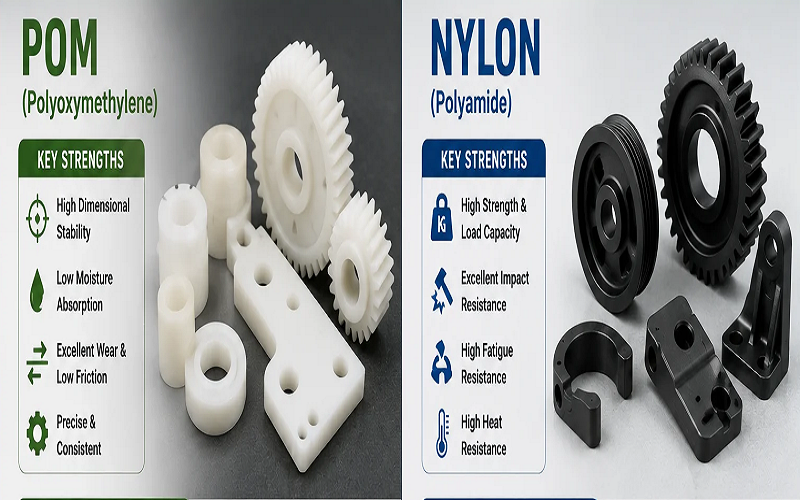
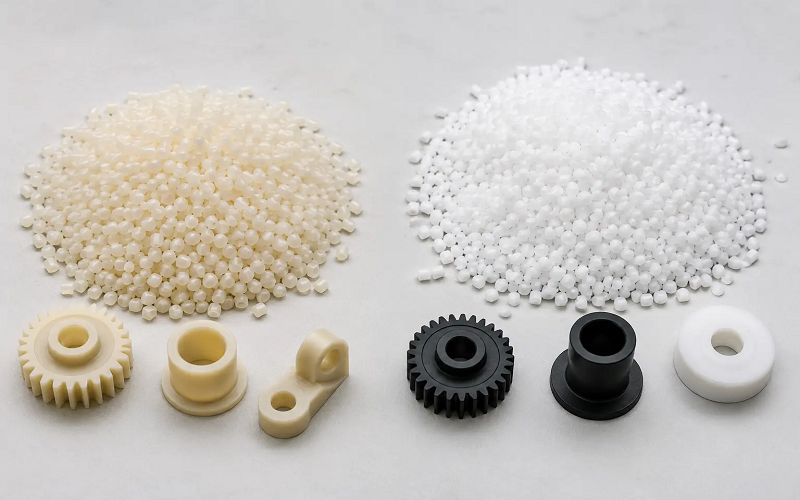
In the field of engineering plastics, Nylon and Polyoxymethylene (POM) are two common and widely used materials. Each possesses unique mechanical properties and chemical characteristics, making them suitable for manufacturing various industrial and automotive components.
This article provides a detailed comparison of Nylon vs POM in terms of wear resistance, dimensional stability, temperature resistance, and other aspects, helping you better understand the advantages and disadvantages of these two materials to make more informed choices in practical applications.
Nylon vs POM : Chemical Structure & Material Types
Nylon (Polyamide / PA) and Polyoxymethylene (POM) are two common engineering plastics with the following chemical structures and typical grades:
Nylon (Polyamide / PA)
Nylon’s chemical structure is formed by the polycondensation of diamines with dicarboxylic acids (such as PA66) or amino acids/caprolactam (such as PA6).
The molecular chains contain repeating amide bonds, and these polar amide groups can form hydrogen bonds with water molecules, resulting in nylon’s high moisture absorption.
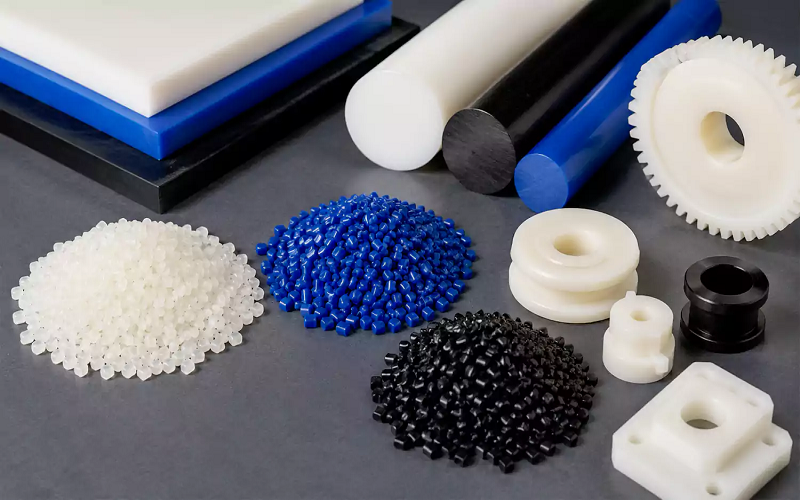
Common nylon materials include PA6, PA66, and PA12, with PA12 exhibiting significantly lower moisture absorption than PA6 and PA66, making it suitable for applications requiring higher dimensional stability.
Nylon has excellent mechanical properties, making it suitable for structural components subjected to dynamic loads or impacts.
Its self-lubricating properties enable good performance in friction components like gears and bearings, but its moisture absorption affects its mechanical properties and dimensional stability.
POM (Polyoxymethylene)
Polyoxymethylene (POM) is a polyacetal plastic with molecular chains composed of repeating –CH2–O– units. It comes in two types: homopolymer (such as Delrin) and copolymer. Homopolymers typically have higher strength and rigidity, while copolymers offer better chemical and thermal stability.
Unlike nylon, POM’s molecular backbone is less polar and has very low water absorption, resulting in excellent dimensional stability and moisture resistance.
POM is a highly crystalline thermoplastic with excellent mechanical strength and rigidity, suitable for precision parts needing low friction and high dimensional stability. It is commonly used to produce gears, bearings, sliding parts, and precision mechanical components.
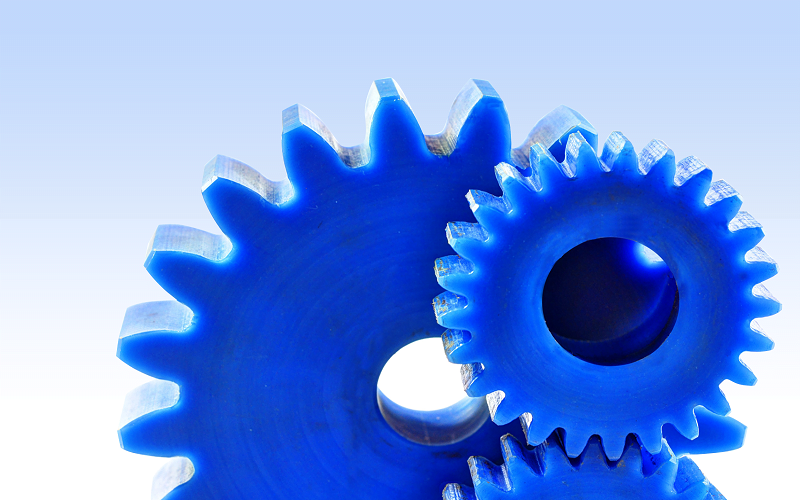
Both materials have typical reinforced grades, such as glass fiber reinforced nylon and lubricated or UV-stabilized POM, which can significantly improve mechanical properties and heat resistance through additives.
Key Differences Between POM And Nylon Properties
When comparing POM vs nylon, several key properties differentiate these two popular plastic materials, influencing their suitability for various applications.
Mechanical Properties
POM is known for its rigidity, load-bearing capacity, and low friction coefficient, making it ideal for manufacturing precision gears, bearings, and moving parts that require wear resistance and long service life.
Nylon has higher tensile strength and good toughness than POM, making it suitable for structural components subjected to dynamic loads and impacts. It also has good wear resistance and some grades are reinforced with glass fiber.
Moisture Absorption And Dimensional Stability
Nylon absorbs moisture readily due to its polar amide groups, with typical absorption rates up to 7%. This moisture absorption causes nylon to swell, leading to dimensional drift and reduced mechanical performance in humid environments or wet environments.
In contrast, POM exhibits very low moisture absorption (around 0.9%), resulting in superior dimensional stability and minimal swelling than nylon in humid conditions. This makes POM an excellent choice for applications requiring tight tolerances and consistent performance in humid environments.
Thermal Properties
Nylon can withstand high temperature resistance, with some grades tolerating temperatures up to 150°C, making it suitable for automotive and industrial applications exposed to extreme heat.
POM offers excellent heat resistance as well but typically operates effectively within a temperature range from -40°C to 100°C.
However, POM maintains better thermal properties and dimensional stability under continuous heat exposure, whereas nylon may experience dimensional drift due to moisture absorption at elevated temperatures.
Chemical Resistance
POM excels in chemical resistance, showing excellent resistance to organic solvents, oils, fuels, and many industrial chemicals, making it ideal for piping systems and automotive fuel components.
Nylon resists oils and has good chemical resistance but is less resistant to strong acids or bases compared to POM. Nylon’s moisture absorption can also affect its chemical stability over time.
Environmental Resistance
POM has excellent weather resistance and UV resistance when stabilized, making it suitable for outdoor and industrial equipment exposed to environmental stress.
Nylon, while wear resistant and durable, is more susceptible to environmental factors like moisture and UV exposure, which can degrade its properties over time.
In summary, due to its moisture absorption, excellent toughness, and good high-temperature resistance, nylon is suitable for applications subjected to impact loads or high-temperature environments.
In contrast, if the application prioritizes superior chemical resistance, low moisture absorption, better dimensional stability, and excellent wear resistance (especially in humid or wet environments), then POM (polyoxymethylene) would be the more ideal choice.
| Property | Nylon (Polyamide) | POM (Polyoxymethylene / Acetal) |
|---|---|---|
| Mechanical Strength | High tensile strength and good toughness | High rigidity and excellent stiffness |
| Wear Resistance | Good wear resistance; self-lubricating | Excellent wear resistance; low friction |
| Moisture Absorption | Absorbs moisture up to 7%, affects dimensions | Very low moisture absorption (~0.9%), excellent dimensional stability |
| Thermal Resistance | Can withstand temperatures up to 150°C | Effective range from -40°C to 100°C |
| Chemical Resistance | Good resistance to oils and fuels; less resistant to strong acids/bases | Excellent resistance to oils, fuels, solvents, and many chemicals |
| Dimensional Stability | Affected by moisture absorption | High dimensional stability, minimal swelling |
| Environmental Resistance | Susceptible to moisture and UV degradation | Good weather and UV resistance with stabilizers |
| Flexibility and Toughness | More flexible and impact resistant | More rigid and dimensionally stable |
Nylon Injection Molding vs POM Injection Molding
Both nylon and POM are widely used in plastic injection molding.
Nylon Injection Molding
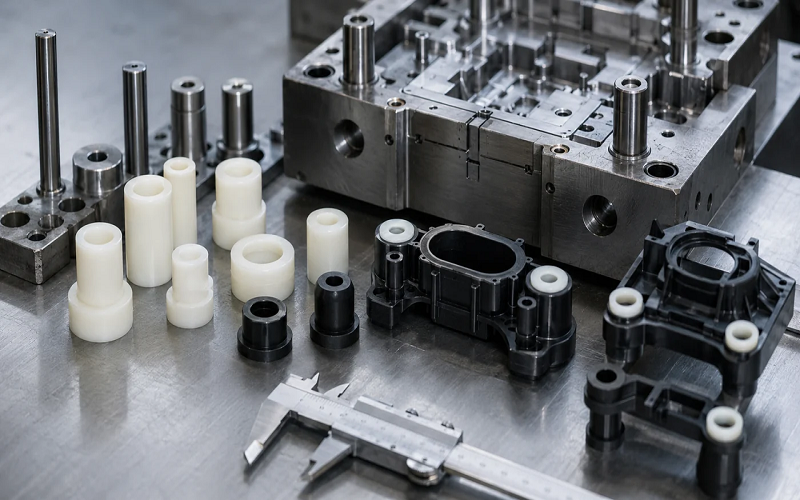
Nylon’s high moisture absorption means it must be thoroughly dried before molding, typically at temperatures between 80°C and 100°C for several hours.
Its processing temperatures are relatively high, typically ranging from 230°C to 300°C depending on the grade. Mold temperatures are usually maintained between 80°C and 120°C to enhance crystallinity and improve part strength.
POM Injection Molding
POM has lower processing temperatures (about 190°C to 230°C) and generally requires less stringent drying due to its low moisture absorption.
In POM injection molding process,mold temperatures are typically between 40°C and 80°C. POM’s high crystallinity and low shrinkage contribute to excellent dimensional control and surface finish.
Because POM is sensitive to overheating and prolonged residence time in the barrel, careful temperature control and machine cleaning are essential to prevent degradation and odor issues.
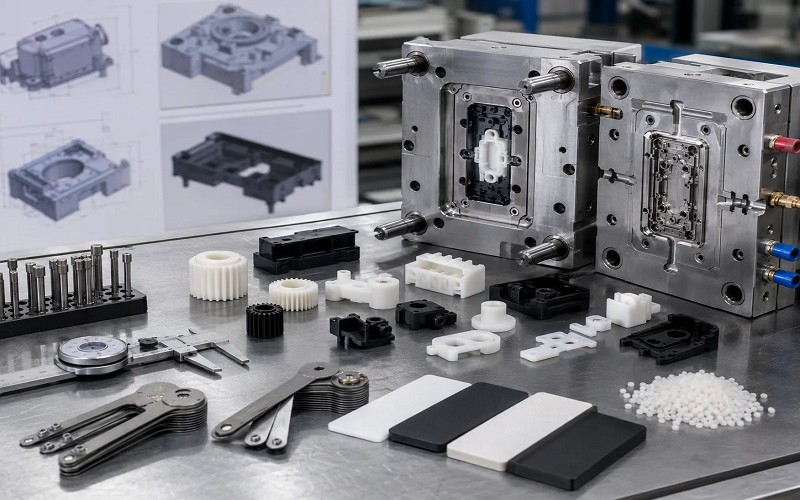
Understanding these injection molding parameters is crucial for optimizing the production quality and performance of nylon and POM parts, ensuring that each material’s unique characteristics are accommodated during processing.
Typical Applications Of Nylon And POM
Although Nylon and POM both belong to engineering plastics, their different performance focuses result in distinct practical application scenarios.
Applications Suitable For Nylon
Nylon is commonly chosen for applications requiring high impact resistance, toughness, and load-bearing capacity.
Typical uses include gears, bearings, conveyor belts, automotive components like engine covers and brackets, structural parts in industrial machinery, and components subject to vibration or dynamic loads.
Nylon’s ability to absorb water makes it suitable for parts needing some flexibility and vibration damping, such as bushings and shock absorbers.
Applications Suitable For POM
POM (acetal) is preferred for precision mechanical parts demanding low friction, high dimensional stability, and long service life.
Common applications include precision gears, sliding bearings, cams, conveyor rollers, fuel system components in automotive industries, electrical insulators, and industrial machinery parts exposed to humid or wet environments.
POM’s excellent chemical resistance and wear properties also make it ideal for high-volume, high-precision applications requiring consistent performance over time.
When deciding between the two, choose nylon for applications where toughness and impact resistance are prioritized, especially in cost-sensitive projects. Opt for POM when superior dimensional stability, low friction, and excellent wear resistance are essential for the longevity and precision of the parts.
Nylon vs POM : How To Choose ?
Choosing between Nylon and POM depends on the specific requirements of your application, including mechanical demands, environmental conditions, cost considerations, and desired longevity. Here are some key factors to consider when making your decision:
Mechanical Requirements
If your project requires components with high tensile strength and good toughness to withstand impact and dynamic loads, Nylon is often the better choice. Its flexibility and resilience make it ideal for structural parts that must absorb shock or vibration.
Conversely, if your application demands high load bearing capacity, rigidity, and excellent abrasion resistance, POM is preferred. POM’s superior mechanical properties, including good friction resistance and high volume resistance, make it especially suitable for precision parts like plastic gears and bearings.
Environmental Conditions
Consider the operating environment carefully. Nylon absorbs water, which can lead to swelling and dimensional changes, potentially affecting performance in humid or wet conditions.
POM exhibits excellent moisture resistance and processing dimensional stability, maintaining consistent dimensions even in high humidity. For applications exposed to chemicals, oils, or fuels, POM generally offers better chemical resistance, while Nylon performs well but may degrade faster under harsh chemical exposure.
Wear and Friction
For moving parts requiring low friction and long service life, POM is often the material of choice due to its low coefficient of friction and excellent wear resistance. It is inherently self-lubricating, reducing maintenance needs. Nylon also provides good wear resistance and self-lubrication but may not perform as well in high-friction or high-wear environments, especially when moisture is present.
Thermal Considerations
Nylon can withstand higher temperatures, up to around 150°C for some grades, making it suitable for applications exposed to elevated heat. POM typically operates effectively between -40°C and 100°C and maintains better dimensional stability under continuous heat exposure.
Cost and Long-Term Value
PA is generally more cost-effective than POM, making it attractive for budget-sensitive projects. However, its moisture absorption can increase long-term maintenance costs.
POM, although more expensive initially, tends to offer better long-term value in high-wear or precision applications due to its durability and stability.
Application Examples
Use Nylon for gears, bearings, automotive components, and structural parts where impact resistance and toughness are critical.
Choose POM sheets and components for precision gears, sliding parts, fuel system components, and industrial machinery parts requiring excellent dimensional stability and low friction.
Ultimately, the choice between Nylon and POM should be guided by a thorough evaluation of the mechanical, environmental, and economic factors relevant to your specific use case.
Consulting with material specialists and testing under actual operating conditions can also help ensure optimal material selection.